Mercaptopurine and the TPMT and NUDT15 genes
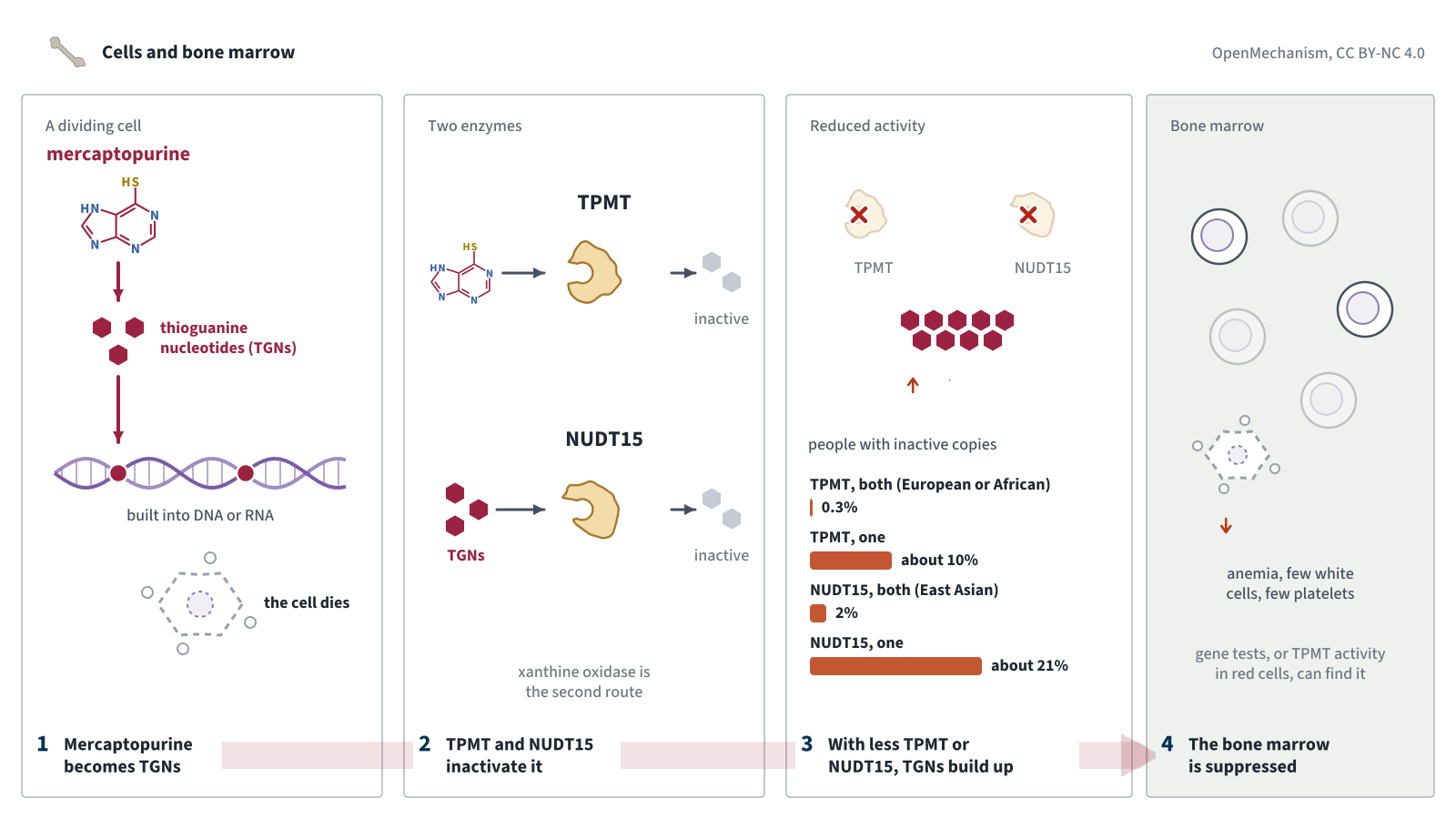
Inside cells mercaptopurine becomes thioguanine nucleotides (TGNs), which stop dividing cells and kill them. TPMT inactivates mercaptopurine, and NUDT15 inactivates thiopurine metabolites. People with low TPMT or NUDT15 activity build up too many TGNs on usual doses and are at higher risk of severe bone marrow suppression.
- Kind
- In the body
- Medicines
- Mercaptopurine
- Sources
- 4
For teachers: download this drawing.
Step by step
Mercaptopurine becomes TGNs. Mercaptopurine, a purine analog, is taken into cells and activated into metabolites, among them thioguanine nucleotides (TGNs). Built into or , TGNs stop the cell cycle and kill the cell.1
TPMT and NUDT15 inactivate it. TPMT, an enzyme that varies from person to person, inactivates mercaptopurine by adding a methyl group; xanthine oxidase is the other route. NUDT15 inactivates thiopurine metabolites, and in the laboratory it made them less harmful to cells.1,2
What the source says
“Mercaptopurine is inactivated via two major pathways.”
Source 1“One is thiol methylation, which is catalyzed by the polymorphic enzyme thiopurine S-methyltransferase (TPMT), to form the inactive metabolite methyl-mercaptopurine.”
Source 1“The second inactivation pathway is oxidation, which is catalyzed by xanthine oxidase.”
Source 1“Mechanistically, NUDT15 inactivated thiopurine metabolites and decreased thiopurine cytotoxicity in vitro”
Source 2With less TPMT or NUDT15, TGNs build up. Published studies indicate that people with reduced TPMT or NUDT15 activity build up too many active TGNs in their cells on usual doses. About 1 in 300 people of European or African ancestry have two inactive copies of the TPMT gene and about 10% one; among people of East Asian ancestry, 2% have two inactive copies of NUDT15 and about 21% one, against under 1% with NUDT15 deficiency in European or African ancestry.1
What the source says
“Several published studies indicate that patients with reduced TPMT or NUDT15 activity receiving usual doses of mercaptopurine, accumulate excessive cellular concentrations of active 6-TGNs, and are at higher risk for severe myelosuppression.”
Source 1“Approximately 0.3% (1:300) of patients of European or African ancestry have two loss-of-function alleles of the TPMT gene and have little or no TPMT activity (homozygous deficient or poor metabolizers), and approximately 10% of patients have one loss-of-function TPMT allele leading to intermediate TPMT activity (heterozygous deficient or intermediate metabolizers).”
Source 1“Among patients of East Asian ancestry (i.e., Chinese, Japanese, Vietnamese), 2% have two loss-of-function alleles of the NUDT15 gene, and approximately 21% have one loss-of-function allele.”
Source 1“NUDT15 deficiency is detected in <1% of patients of European or African ancestry.”
Source 1The bone marrow is suppressed. They are at higher risk of severe bone marrow suppression: anemia, few white cells, few platelets, or any mix of these. In children with leukemia, NUDT15 variants that cut its activity by 74 to 100% went with thiopurine intolerance, too much of the active metabolites and toxicity. Gene tests, or a test of TPMT activity in red blood cells, can find reduced activity.1,2
What the source says
“are at higher risk for severe myelosuppression.”
Source 1“The most consistent, dose-related adverse reaction is myelosuppression, manifested by anemia, leukopenia, thrombocytopenia, or any combination of these.”
Source 1“In 270 children enrolled in clinical trials for acute lymphoblastic leukemia in Guatemala, Singapore and Japan, we identified four NUDT15 coding variants (p.Arg139Cys, p.Arg139His, p.Val18Ile and p.Val18_Val19insGlyVal) that resulted in 74.4-100% loss of nucleotide diphosphatase activity.”
Source 2“Loss-of-function NUDT15 diplotypes were consistently associated with thiopurine intolerance across the three cohorts”
Source 2“patients with defective NUDT15 alleles showed excessive levels of thiopurine active metabolites and toxicity.”
Source 2“TPMT genotyping or phenotyping (red blood cell TPMT activity) and NUDT15 genotyping can identify patients who have reduced activity of these enzymes.”
Source 1
See also
Medicine pages: mercaptopurine.
Other pages on what the body does with a medicine (cancer): fluorouracil and the DPYD gene; irinotecan and the UGT1A1 gene; and all 16 pages on what the body does with a medicine.
Conditions: acute lymphoblastic leukemia.
Interactions: allopurinol and mercaptopurine.
Sources
- 1Mercaptopurine tablets: FDA label5.1 Myelosuppression; 12.1 Mechanism of Action; 12.3 Pharmacokinetics; 12.5 Pharmacogenomics. Saved copy
- 2NUDT15 polymorphisms alter thiopurine metabolism and hematopoietic toxicityMoriyama T et al. Nat Genet 2016 (abstract). Saved copy
- 3Human thiopurine S-methyltransferase (TPMT) with S-adenosylhomocysteinePDB 2BZG; Wu, H. et al. Proteins 2007;67:198. The TPMT outline in the drawing is traced from this structure. Saved copy
- 4Human NUDT15 with 6-thio-GMP, a thiopurine nucleotidePDB 5LPG; Valerie, N.C. et al. Cancer Res. 2016;76:5501-5511. The NUDT15 outline in the drawing is traced from this structure. Saved copy
Notes and limits
- Which of the effects of mercaptopurine and its metabolites mainly kills cells is not known.1
Notes that apply to every page are on How to read a page.
Spotted a mistake? Report an error (hello@openmechanism.com). Since launch, every published error we fix is listed on the corrections page.
Cite this page
Tran D. Mercaptopurine and the TPMT and NUDT15 genes [Internet]. OpenMechanism; 2026 [updated 2026 Oct 20; cited 2026 Oct 20]. Available from: https://openmechanism.com/explained/mercaptopurine-tpmt-and-nudt15