Dorzolamide
Dorzolamide blocks carbonic anhydrase II in the eye. The label proposes this slows fluid production by the ciliary processes, reducing raised pressure inside the eye.
- Acts on
- Carbonic anhydrase II
- Where
- The eye's fluid-producing tissue
- Medicine type
- Small molecule
- Used for
- Eyes & ears
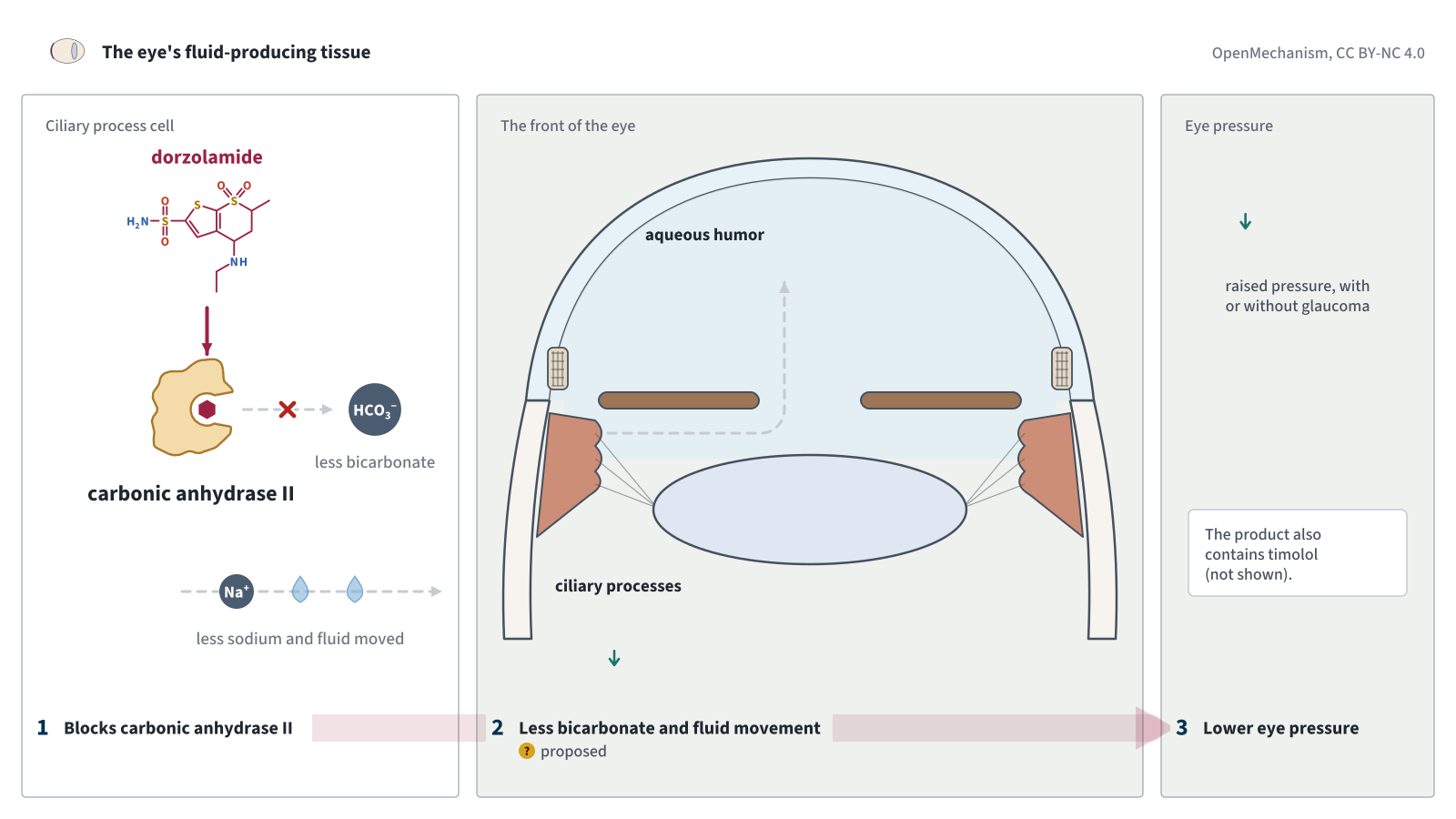
Step 2: proposed
The dorzolamide and timolol label says: Inhibition of carbonic anhydrase in the ciliary processes of the eye decreases aqueous humor secretion, presumably by slowing the formation of bicarbonate ions with subsequent reduction in sodium and fluid transport.
Source 1: Dorzolamide hydrochloride and timolol maleate: FDA label, 12.1 Mechanism of Action
Clinical study: In a double-masked, randomized 1-year trial in 523 people with open-angle glaucoma or ocular hypertension, dorzolamide eye drops were compared with timolol and betaxolol; the trial measured intraocular pressure (eye pressure), not bicarbonate formation or fluid transport: At 1 year, the mean percent reduction in intraocular pressure at peak of 2% dorzolamide, 0.5% timolol, and 0.5% betaxolol was approximately 23%, 25%, and 21%, respectively.
Strahlman E et al., Arch Ophthalmol 1995 (PMID 7639651)
This study was picked with a literature search and is not yet checked by our reviewer.
How it works
Blocks carbonic anhydrase II. The dorzolamide component inhibits human carbonic anhydrase II.1
Less bicarbonate and fluid movement. The label proposes slower bicarbonate formation and reduced sodium and fluid transport in the ciliary processes.1
Lower eye pressure. Lower aqueous-humor secretion reduces elevated intraocular pressure.1
For teachers: download this drawing or build a slide deck.
See also
Condition pages: glaucoma.
Sources
- 1Dorzolamide hydrochloride and timolol maleate: FDA label12.1 Mechanism of Action
- 2ChEMBL CHEMBL218490Target and action classification: Carbonic anhydrase II inhibitor
- 3A double-masked, randomized 1-year study comparing dorzolamide (Trusopt), timolol, and betaxolol. International Dorzolamide Study GroupStrahlman E et al. Arch Ophthalmol 1995 (abstract)
Also used for the drawing
The carbonic anhydrase outline is traced from the crystal structure below.
- 4Human carbonic anhydrase II with dorzolamidePDB 4M2U; Pinard, M.A. et al. Bioorg.Med.Chem. 2013; 21:7210-7215
Spotted a mistake? Report an error (hello@openmechanism.com). Since launch, every published error we fix is listed on the corrections page.
Notes and limits
- A schematic teaching drawing: not to scale, not exact structures, binding poses or a complete pathway, and not a guide to dosing, treatment or how a person will respond.
- Other medicines in the same family may not follow every step or share the same clinical endpoint.
- The steps are in the order that explains them; one step is said to cause the next only where the source says so.
- The selected source product also contains timolol. This recipe isolates the explicitly described dorzolamide component and does not attribute combination effects to it alone.
- The bicarbonate/fluid route is described as presumptive in the label.
All recorded limits are on the evidence page, and notes that apply to every page are on How to read a page. Version 1.0.0, not yet medically reviewed.
Cite this page
Tran D. Dorzolamide [Internet]. OpenMechanism; 2026 [updated 2026 Oct 14; cited 2026 Oct 14]. Available from: https://openmechanism.com/medicines/dorzolamide