Reversing rocuronium with sugammadex or neostigmine
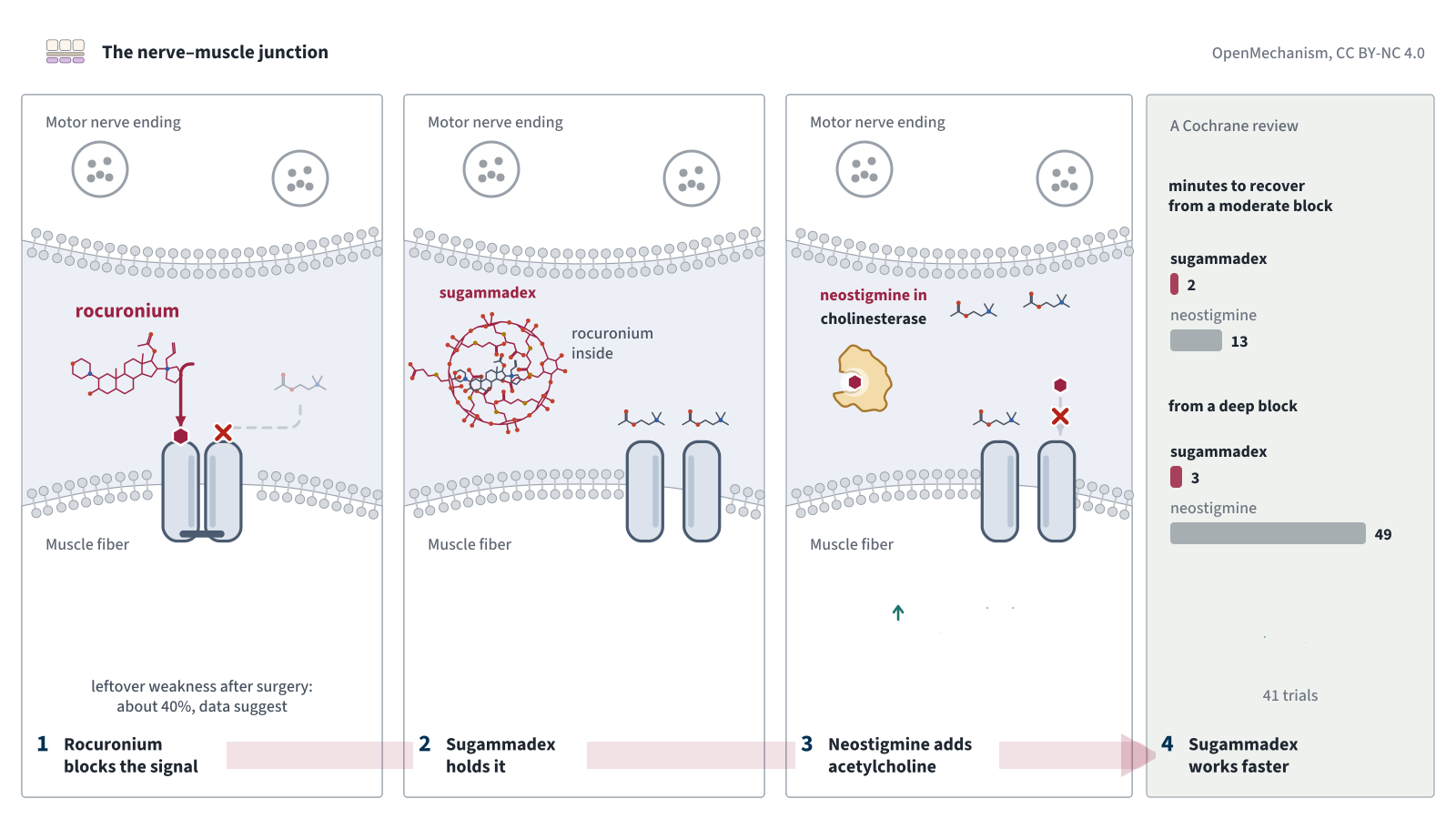
Rocuronium relaxes the muscles during surgery by competing with acetylcholine at the nerve–muscle junction. Afterward its block is reversed in one of two ways: sugammadex holds rocuronium so less reaches the receptors, and neostigmine blocks cholinesterase so more acetylcholine outcompetes it. In trials sugammadex worked faster, with fewer side effects.
- Kind
- Interaction
- Medicines
- Sugammadex, Neostigmine, Rocuronium
- Sources
- 8
For teachers: download this drawing.
Step by step
Rocuronium blocks the signal. Rocuronium is used with general anesthesia to ease placing a breathing tube and to relax the muscles during surgery or on a ventilator. It competes for the acetylcholine receptors at the motor end plate, so the muscle does not respond. Leftover weakness after surgery appears common: data suggest about 40% of patients in the recovery room still have some, which may cause breathing problems.1,2
What the source says
“Rocuronium Bromide Injection is indicated as an adjunct to general anesthesia to facilitate both rapid sequence and routine tracheal intubation, and to provide skeletal muscle relaxation during surgery or mechanical ventilation.”
Source 1“It acts by competing for cholinergic receptors at the motor end-plate.”
Source 1“Data suggest that residual neuromuscular block is a common complication in the postanesthesia care unit, with approximately 40% of patients exhibiting a train-of-four ratio <0.9.”
Source 2“Furthermore, observational and randomized clinical trials have demonstrated that incomplete neuromuscular recovery during the early postoperative period may result in acute respiratory events (hypoxemia and airway obstruction), unpleasant symptoms of muscle weakness, longer postanesthesia care unit stays, delays in tracheal extubation, and an increased risk of postoperative pulmonary complications.”
Source 2Sugammadex holds it. Sugammadex, a modified gamma cyclodextrin, forms a complex with rocuronium, so less of it can reach the acetylcholine receptors at the junction, and the block is reversed. It is used for this after rocuronium or vecuronium in surgery.3
What the source says
“BRIDION is a modified gamma cyclodextrin. It forms a complex with the neuromuscular blocking agents rocuronium and vecuronium, and it reduces the amount of neuromuscular blocking agent available to bind to nicotinic cholinergic receptors in the neuromuscular junction. This results in the reversal of neuromuscular blockade induced by rocuronium and vecuronium.”
Source 3“BRIDION ® is indicated for the reversal of neuromuscular blockade induced by rocuronium bromide and vecuronium bromide in adult and pediatric patients undergoing surgery.”
Source 3Neostigmine adds acetylcholine. Neostigmine blocks , the enzyme that breaks acetylcholine down. More acetylcholine stays in the gap and competes with the relaxant for the same binding site, reversing the block; rocuronium's label names neostigmine as one that counters it. The extra acetylcholine also strengthens its muscarinic effects.1,4
What the source says
“Neostigmine methylsulfate is a competitive cholinesterase inhibitor. By reducing the breakdown of acetylcholine, neostigmine methylsulfate induces an increase in acetylcholine in the synaptic cleft which competes for the same binding site as nondepolarizing neuromuscular blocking agents, and reverses the neuromuscular blockade.”
Source 4“This action is antagonized by acetylcholinesterase inhibitors, such as neostigmine and edrophonium.”
Source 1“Neostigmine methylsulfate-induced increases in acetylcholine levels results in the potentiation of both muscarinic and nicotinic cholinergic activity.”
Source 4“BLOXIVERZ, is a cholinesterase inhibitor, indicated for the reversal of the effects of non-depolarizing neuromuscular blocking agents after surgery.”
Source 4Sugammadex works faster. A Cochrane review of 41 trials found that sugammadex reversed a moderate rocuronium block in about 2 minutes, against about 13 with neostigmine, and a deep block in about 3, against 49. People given sugammadex had 40% fewer side effects, among them slow heart rate and signs of leftover paralysis; serious events came in under 1% with either.5
What the source says
“We included 41 studies (4206 participants) in this updated review, 38 of which were new studies.”
Source 5“Sugammadex 2 mg/kg was 10.22 minutes (6.6 times) faster then neostigmine 0.05 mg/kg (1.96 vs 12.87 minutes) in reversing NMB from the second twitch (T2) to TOFR > 0.9”
Source 5“Sugammadex 4 mg/kg was 45.78 minutes (16.8 times) faster then neostigmine 0.07 mg/kg (2.9 vs 48.8 minutes) in reversing NMB from post-tetanic count (PTC) 1 to 5 to TOFR > 0.9”
Source 5“Patients receiving sugammadex had 40% fewer adverse events compared with those given neostigmine.”
Source 5“Specifically, risks of bradycardia (RR 0.16, NNTB 14; GRADE: moderate quality), PONV (RR 0.52, NNTB 16; GRADE: low quality), and overall signs of postoperative residual paralysis (RR 0.40, NNTB 13; GRADE: moderate quality) were reduced.”
Source 5“Both sugammadex and neostigmine were associated with serious adverse events in less than 1% of patients, and data showed no differences in risk of serious adverse events between groups (RR 0.54; GRADE: low quality).”
Source 5
See also
Medicine pages: sugammadex, neostigmine and rocuronium.
Other interactions (antidotes & reversal): digoxin immune Fab and digoxin; idarucizumab and dabigatran; leucovorin with methotrexate and with fluorouracil; protamine and heparin; sugammadex and hormonal contraceptives; and all 40 interactions.
The medicine in the body: succinylcholine and the BCHE gene.
Conditions: low blood pressure during anesthesia, organophosphate poisoning and myasthenia gravis.
Sources
- 1Rocuronium bromide injection: FDA label1 Indications and Usage; 12.1 Mechanism of Action. Saved copy
- 2Residual neuromuscular block: lessons unlearned. Part IMurphy GS, Brull SJ. Anesth Analg 2010 (abstract). Saved copy
- 3Bridion (sugammadex): FDA label1 Indications and Usage; 12.1 Mechanism of Action. Saved copy
- 4Bloxiverz (neostigmine methylsulfate) injection: FDA label1 Indications and Usage; 12.1 Mechanism of Action; 12.2 Pharmacodynamics. Saved copy
- 5Efficacy and safety of sugammadex versus neostigmine in reversing neuromuscular blockade in adultsHristovska AM et al. Cochrane Database Syst Rev 2017 (abstract). Saved copy
- 6Bridion (sugammadex): FDA label5 Warnings and Precautions. Saved copy
- 7Bloxiverz (neostigmine methylsulfate) injection: FDA label5.1 Bradycardia. Saved copy
- 8Human acetylcholinesterase with donepezilPDB 4EY7; Cheung, J. et al. J.Med.Chem. 2012;55:10282-10286. The cholinesterase outline in the drawing is traced from this structure. Saved copy
Notes and limits
- Sugammadex has caused serious allergic reactions, including anaphylaxis, and marked slowing of the heart within minutes, some cases ending in cardiac arrest.6
- The block can persist after sugammadex or come back after the breathing tube is out, so its label calls for breathing support until breathing is adequate.6
- Neostigmine has been linked to a slow heart rate; its label calls for atropine or glycopyrrolate first to lessen that risk.7
Notes that apply to every page are on How to read a page.
Spotted a mistake? Report an error (hello@openmechanism.com). Since launch, every published error we fix is listed on the corrections page.
Cite this page
Tran D. Reversing rocuronium with sugammadex or neostigmine [Internet]. OpenMechanism; 2026 [updated 2026 Oct 20; cited 2026 Oct 20]. Available from: https://openmechanism.com/explained/reversing-rocuronium