Transthyretin amyloid heart disease (ATTR-CM)
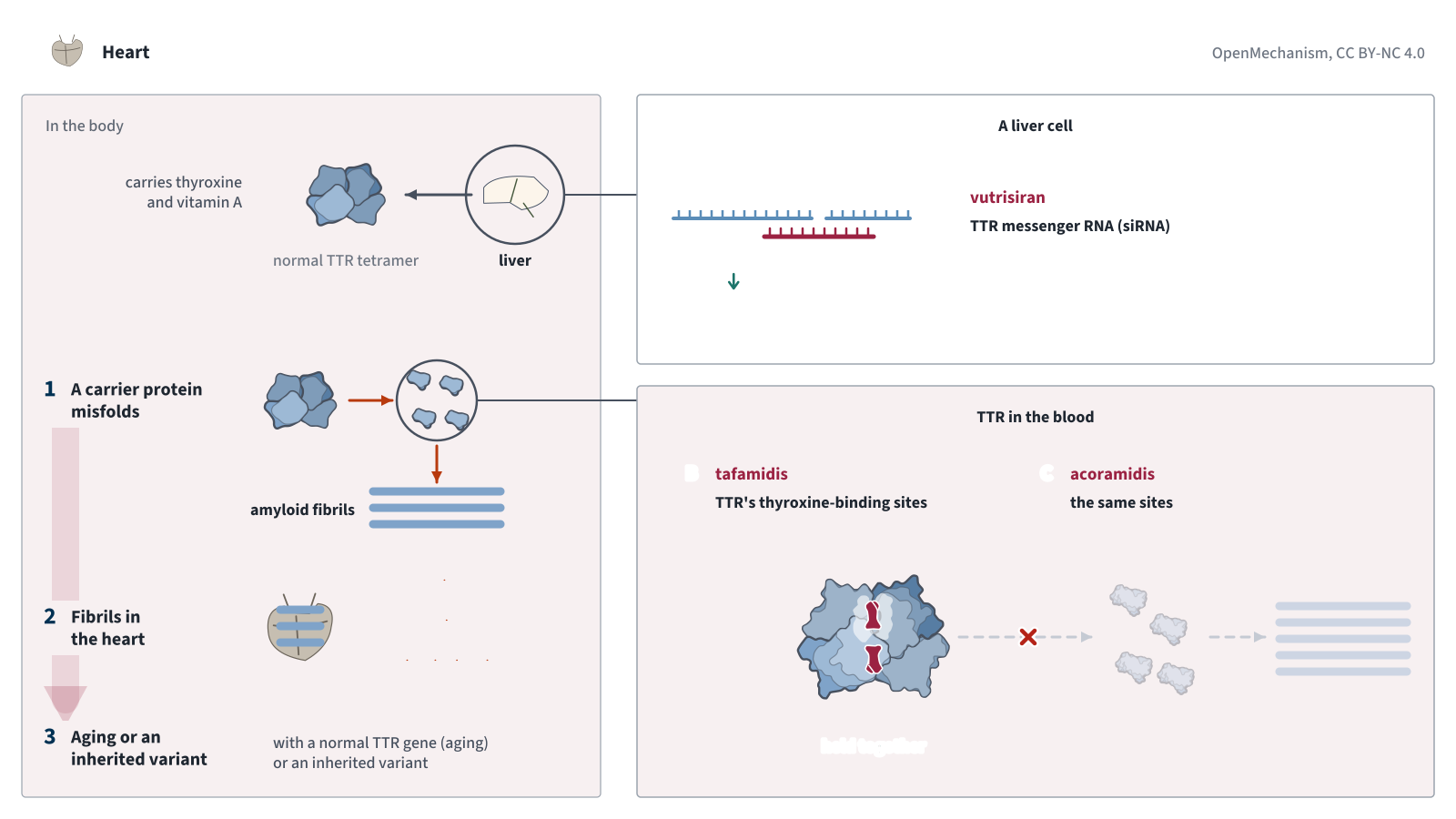
Transthyretin (TTR), a liver-made carrier protein, can misfold into amyloid fibrils that build up in the heart, causing heart failure and rhythm problems. This happens with aging (wild-type) or an inherited variant; untreated, people live a median of about 5 years, and 50,000 to 150,000 people in the US have it. Vutrisiran has the TTR messenger RNA destroyed in liver cells, so less TTR is in the blood; tafamidis and acoramidis hold TTR together so it misfolds less.
- Where
- Heart
- Body system
- Heart, vessels & cholesterol
- Medicines
- 3 medicines
For teachers: download this drawing.
Key terms in this drawing
- mRNA
- Messenger RNA. A copy of a gene that a cell reads to make a protein.
- RNA
- Ribonucleic acid. A molecule copied from DNA; messenger RNA carries a gene's instructions.
- siRNA
- Small interfering RNA. A short double-stranded RNA that guides the cell to destroy a matching messenger RNA.
- TTR
- Transthyretin. A blood protein that can misfold and build up as amyloid.
What goes wrong
A carrier protein misfolds. Transthyretin () is made mainly by the liver and carries thyroid hormone and vitamin A. When it misfolds it can form amyloid fibrils.1
What the source says
“Transthyretin (TTR) protein transports thyroxine (thyroid hormone) and retinol (vitamin A) and is synthesized predominantly by the liver.”
Source 1Fibrils in the heart. The fibrils build up in the heart and cause heart failure, conduction block or irregular rhythms such as atrial fibrillation.1
What the source says
“When the TTR protein misfolds, it can form amyloid fibrils that deposit in the heart causing heart failure, heart conduction block, or arrhythmia such as atrial fibrillation.”
Source 1Aging or an inherited variant. It happens with a normal TTR gene (wild-type, linked to aging) or with an inherited variant. The most common variant, Val122Ile, is carried by 3.4% of African American people.1
What the source says
“ATTR can occur in association with normal TTR genetic sequence (wild-type ATTR) or with abnormal TTR genetic sequence (variant ATTR).”
Source 1“The most common genetic variant is Val122Ile (pV142I), an allele with an origin in West African countries, that is present in 3.4% of African American individuals in the US or approximately 1.5 million persons.”
Source 1
Where medicines act
- A
Vutrisiran: less TTR made
Vutrisiran is a (siRNA) linked to , which delivers it to liver cells. It has the TTR , mutant and normal, destroyed, so less TTR is in the blood and deposited in tissues. Its label lists it for in adults, to reduce deaths and hospital stays from heart causes and urgent heart failure visits.2
What the source says
“AMVUTTRA contains vutrisiran, a chemically modified double-stranded small interfering ribonucleic acid (siRNA) that targets mutant and wild-type transthyretin (TTR) messenger RNA (mRNA) and is covalently linked to a ligand containing three N -acetylgalactosamine (GalNAc) residues to enable delivery of the siRNA to hepatocytes.”
Source 2“Vutrisiran is a double-stranded siRNA-GalNAc conjugate that causes degradation of mutant and wild-type TTR mRNA through RNA interference, which results in a reduction of serum TTR protein and TTR protein deposits in tissues.”
Source 2“AMVUTTRA is indicated for the treatment of the cardiomyopathy of wild-type or hereditary transthyretin-mediated amyloidosis (ATTR-CM) in adults to reduce cardiovascular mortality, cardiovascular hospitalizations and urgent heart failure visits.”
Source 2 - B
Tafamidis: the protein held together
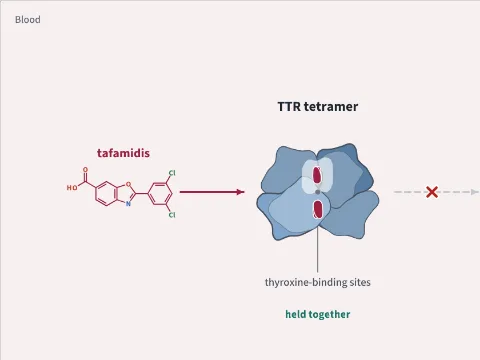
Tafamidis binds TTR at its thyroxine-binding sites, steadying the four-part protein and slowing its breakup, the slowest step in forming amyloid. It lowers deaths and hospital stays from heart causes; in its trial, deaths fell from 42.9% to 29.5%.1,3
What the source says
“Tafamidis binds to TTR at the thyroxine binding sites, stabilizing the tetramer and slowing dissociation into monomers, the rate-limiting step in the amyloidogenic process.”
Source 3“VYNDAQEL and VYNDAMAX are indicated for the treatment of the cardiomyopathy of wild-type or hereditary transthyretin-mediated amyloidosis (ATTR-CM) in adults to reduce cardiovascular mortality and cardiovascular-related hospitalization.”
Source 3“reduced mortality from 42.9% to 29.5%”
Source 1 - C
Acoramidis: the protein held together
Acoramidis also binds TTR at its thyroxine-binding sites and slows the breakup of the four-part protein into single units, the slowest step in forming amyloid. Its label lists it for ATTR-CM in adults, to reduce deaths and hospital stays from heart causes.4
What the source says
“Acoramidis binds TTR at thyroxine binding sites and slows dissociation of the TTR tetramer into its constituent monomers, the rate-limiting step in amyloidogenesis.”
Source 4“ATTRUBY is indicated for the treatment of the cardiomyopathy of wild-type or variant transthyretin-mediated amyloidosis (ATTR-CM) in adults to reduce cardiovascular death and cardiovascular-related hospitalization.”
Source 4
See also
Body system: heart, vessels & cholesterol.
Other conditions: hereditary transthyretin amyloidosis.
Sources
- 1Cardiac amyloidosis due to transthyretin protein: a reviewRuberg FL, Maurer MS. JAMA 2024 (abstract). Saved copy
- 2Amvuttra (vutrisiran): FDA label1 Indications and Usage; 11 Description; 12.1 Mechanism of Action. Saved copy
- 3Vyndaqel and Vyndamax (tafamidis): FDA label1 Indications and Usage; 12.1 Mechanism of Action. Saved copy
- 4Attruby (acoramidis): FDA label1 Indications and Usage; 12.1 Mechanism of Action. Saved copy
- 5Human transthyretin (TTR) tetramer with tafamidis in its two thyroxine-binding sitesPDB 3TCT; Bulawa, C.E. et al. Proc.Natl.Acad.Sci.USA 2012;109:9629-9634. The TTR outline in the drawing is traced from this structure. Saved copy
Notes and limits
- How the fibrils form is not fully understood.1
- A 2024 review says tafamidis was most effective when started early in the disease.1
Notes that apply to every page are on How to read a page.
Spotted a mistake? Report an error (hello@openmechanism.com). Since launch, every published error we fix is listed on the corrections page.
Cite this page
Tran D. Transthyretin amyloid heart disease (ATTR-CM) [Internet]. OpenMechanism; 2026 [updated 2026 Nov 18; cited 2026 Nov 18]. Available from: https://openmechanism.com/conditions/transthyretin-amyloid-cardiomyopathy