Pulmonary arterial hypertension
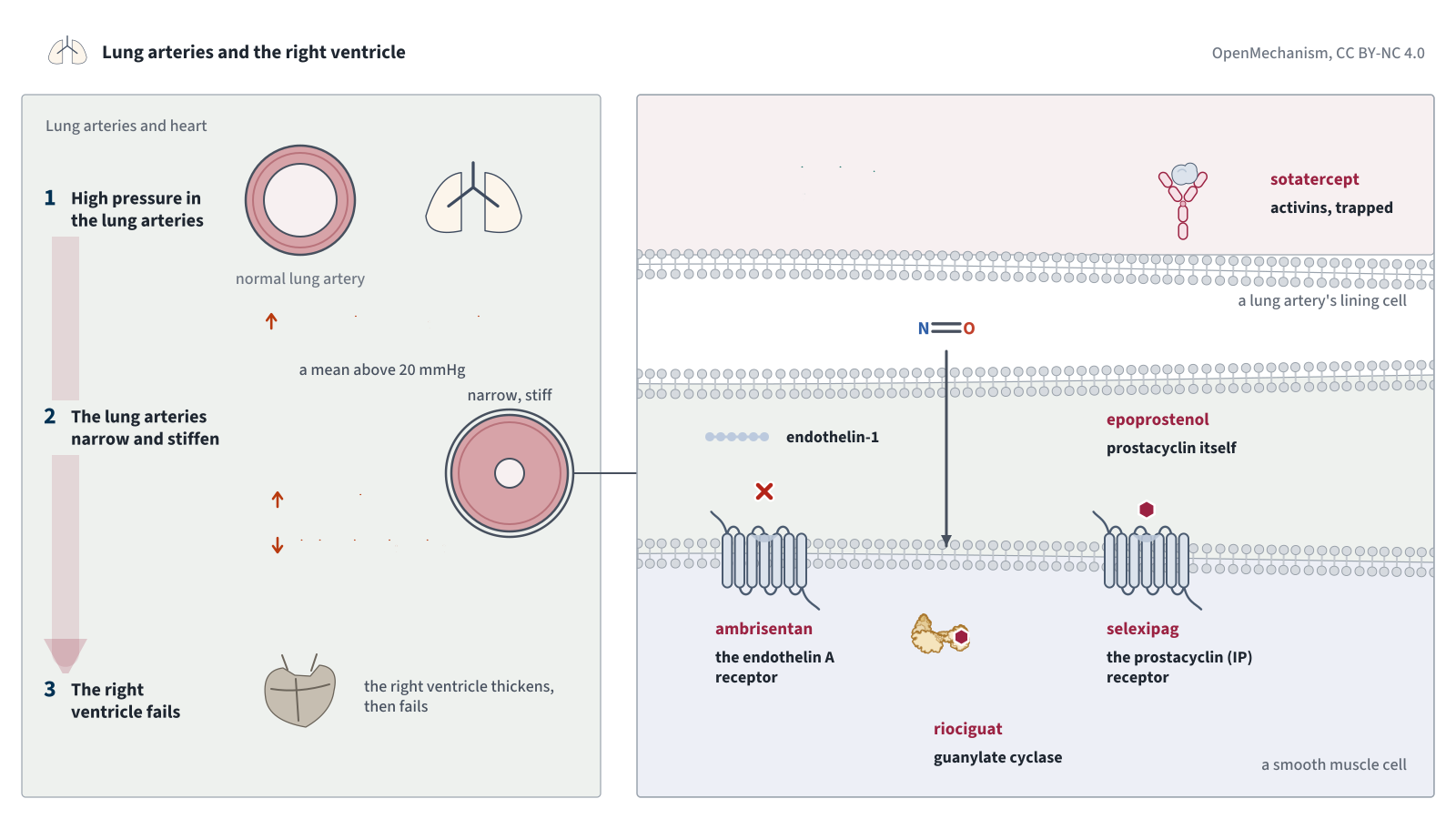
Pulmonary hypertension means raised pressure in the lung arteries (a mean above 20 mmHg). The arteries remodel, narrow and stiffen; nitric oxide signaling is impaired and endothelin-1 is raised. The right ventricle thickens and finally fails. Medicines widen the lung arteries through endothelin, nitric oxide and prostacyclin pathways, or rebalance the signals that make their cells grow.
- Where
- Lung arteries and the right ventricle
- Body system
- Heart, vessels & cholesterol
- Medicines
- 5 medicines
For teachers: download this drawing.
Key terms in this drawing
- ET-1
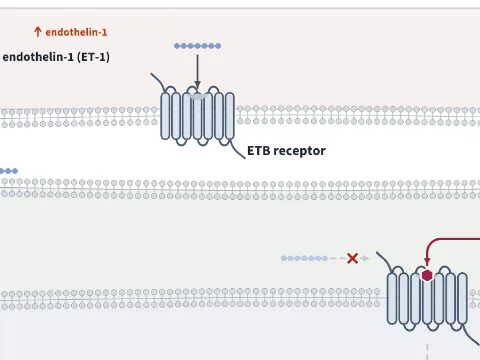
- Endothelin-1. A potent signaling peptide made in the body; it acts on blood-vessel muscle and lining through two receptors, ETA and ETB.
- IP receptor
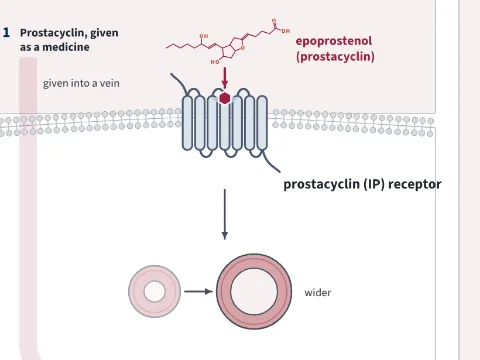
- Prostacyclin receptor. The receptor that prostacyclin and its look-alike medicines are thought to act on; it is linked to making cAMP inside the cell.
- NO
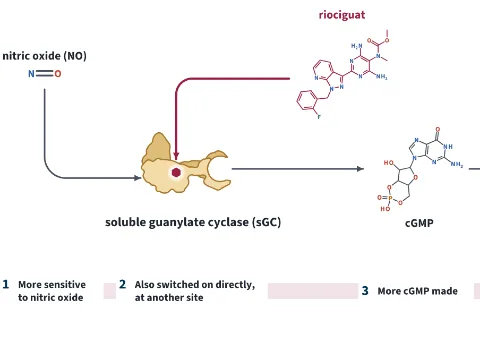
- Nitric oxide. A signal molecule released by nerve endings and the cells lining blood vessels; it makes smooth muscle cells produce cGMP.
What goes wrong
High pressure in the lung arteries. Pulmonary hypertension is raised pressure in the lung (pulmonary) arteries, defined by a mean pressure above 20 mmHg.1
The lung arteries narrow and stiffen. The lung arteries remodel, narrow and stiffen; signaling is impaired, and is raised in the lining of the lung arteries.1,2,3
What the source says
“Across all its forms, pulmonary hypertension is associated with adverse vascular remodelling with obstruction, stiffening and vasoconstriction of the pulmonary vasculature.”
Source 1“Pulmonary hypertension is associated with endothelial dysfunction, impaired synthesis of nitric oxide and insufficient stimulation of the NO-sGC-cGMP pathway.”
Source 2“ET-1 and ET-1 mRNA concentrations are increased as much as 9-fold in the lung tissue of patients with PAH, primarily in the endothelium of pulmonary arteries.”
Source 3The right ventricle fails. Without treatment the right ventricle thickens and finally fails, the main cause of death.1
What the source says
“Without proactive management this leads to hypertrophy and ultimately failure of the right ventricle, the main cause of death.”
Source 1
Where medicines act
- A
Ambrisentan: endothelin A receptor blocked
Ambrisentan blocks the endothelin A receptor.3
What the source says
“Ambrisentan is a high-affinity (K i =0.011 nM) ET A receptor antagonist”
Source 3 - B
Riociguat: the nitric oxide pathway boosted
Riociguat makes soluble guanylate cyclase more sensitive to nitric oxide and also stimulates it directly.2
What the source says
“Riociguat has a dual mode of action. It sensitizes sGC to endogenous NO by stabilizing the NO-sGC binding. Riociguat also directly stimulates sGC via a different binding site”
Source 2 - C
Epoprostenol: prostacyclin widens the arteries
Epoprostenol, prostacyclin itself, directly widens the lung and body arteries.4
What the source says
“direct vasodilation of pulmonary and systemic arterial vascular beds”
Source 4 - D
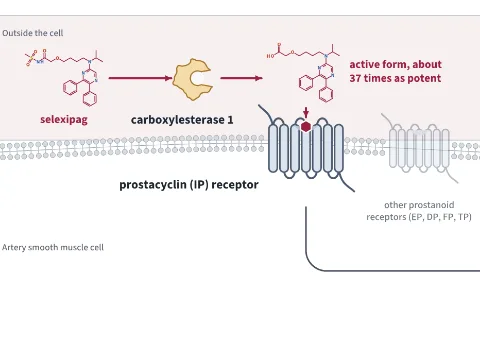
Selexipag: the prostacyclin receptor switched on
Selexipag switches on the prostacyclin () receptor.5
What the source says
“Selexipag is a prostacyclin receptor (IP receptor) agonist that is structurally distinct from prostacyclin.”
Source 5 - E
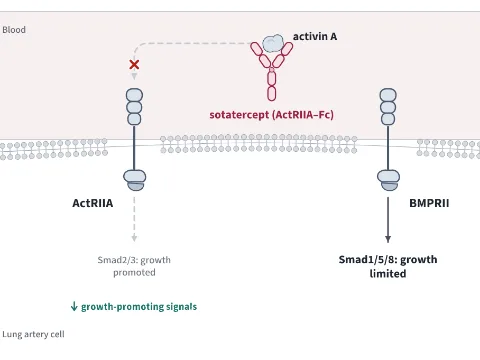
Sotatercept: growth signals rebalanced
Sotatercept traps activins and rebalances the signals that make the lung arteries' cells grow.6
What the source says
“improves the balance between the pro-proliferative (ActRIIA/Smad2/3-mediated) and anti-proliferative (BMPRII/Smad1/5/8-mediated) signaling to modulate vascular proliferation.”
Source 6
See also
Body system: heart, vessels & cholesterol.
Related medicines: sildenafil.
Other conditions: chronic clots in the lung arteries (CTEPH) and erectile dysfunction.
Side effects: why sildenafil can change color vision.
Sources
- 1Pulmonary hypertensionMocumbi A et al. Nat Rev Dis Primers 2024 (abstract). Saved copy
- 2Adempas (riociguat): FDA label1 Indications and Usage; 12.1 Mechanism of Action. Saved copy
- 3Letairis (ambrisentan): FDA label12.1 Mechanism of Action. Saved copy
- 4Veletri (epoprostenol): FDA label12.1 Mechanism of Action. Saved copy
- 5Uptravi (selexipag): FDA label12.1 Mechanism of Action. Saved copy
- 6Winrevair (sotatercept-csrk): FDA label12.1 Mechanism of Action. Saved copy
- 7Human soluble guanylate cyclase activated by nitric oxidePDB 6JT2; Kang, Y. et al. Nature 2019;574:206-210. The soluble guanylate cyclase outline in the drawing is traced from this structure. Saved copy
Notes and limits
- Pulmonary arterial hypertension is one of five groups of pulmonary hypertension, and the rarest kinds; most pulmonary hypertension comes from left-sided heart disease or lung disease.1
Notes that apply to every page are on How to read a page.
Spotted a mistake? Report an error (hello@openmechanism.com). Since launch, every published error we fix is listed on the corrections page.
Cite this page
Tran D. Pulmonary arterial hypertension [Internet]. OpenMechanism; 2026 [updated 2026 Oct 21; cited 2026 Oct 21]. Available from: https://openmechanism.com/conditions/pulmonary-arterial-hypertension