Succinylcholine
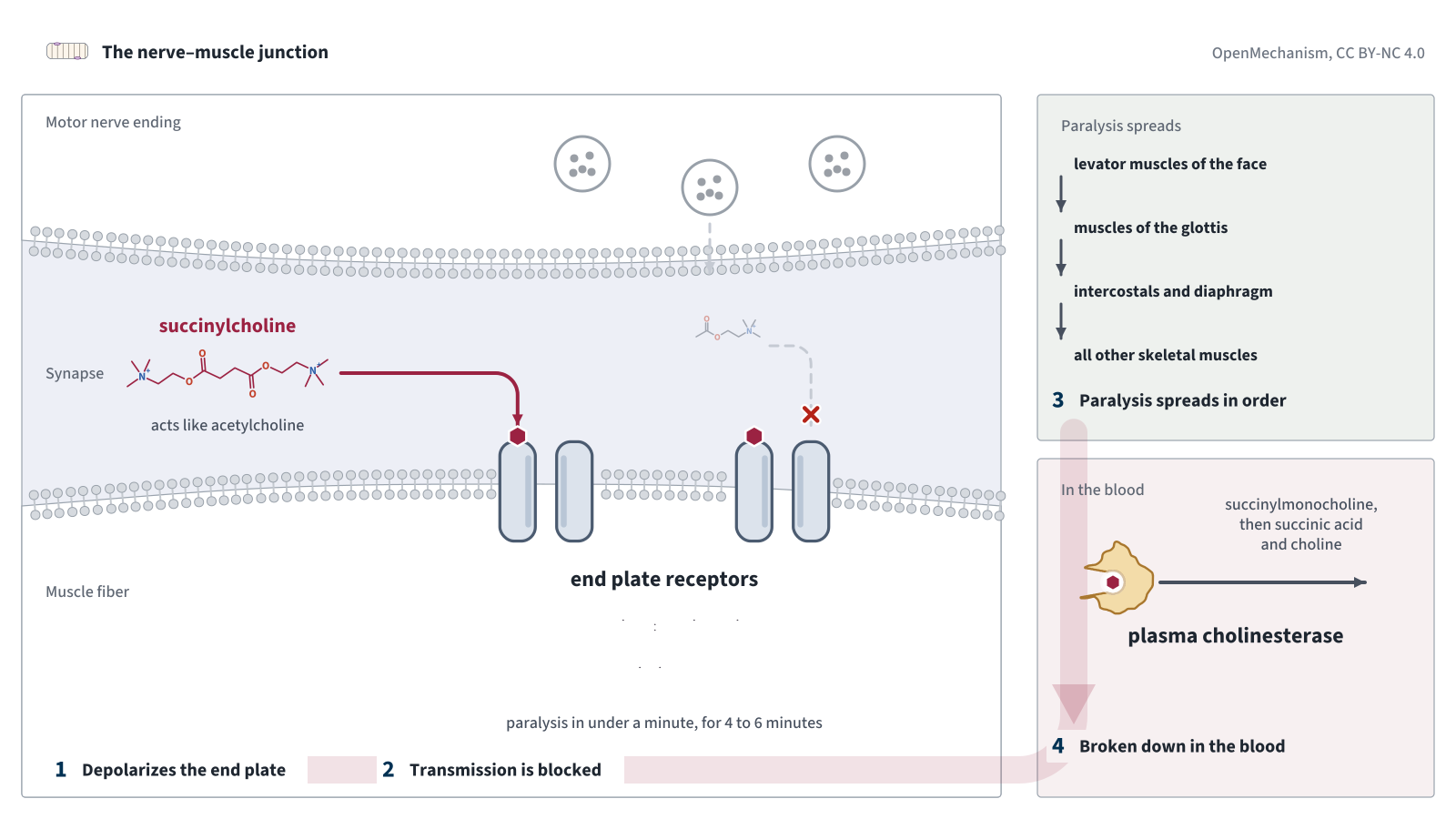
Like acetylcholine, succinylcholine combines with the receptors of the motor end plate and depolarizes it, which may be seen as fasciculations. Transmission then stays blocked as long as enough of it remains: flaccid paralysis starts within a minute and, after a single dose, lasts about 4 to 6 minutes, spreading from the face and glottis to the breathing muscles and all other skeletal muscles. Plasma breaks it down quickly.
- Acts on
- Cholinergic receptors of the motor end plate
- Where
- Nerve-muscle junctions
- Medicine type
- Small molecule
- Used for
- Muscles, bones & joints
- Drug class
- Neuromuscular blockers
Also called Anectine.
Key terms in this drawing
- cholinesterase
- Acetylcholinesterase (cholinesterase). The enzyme that breaks down acetylcholine; blocking it raises the amount of acetylcholine.
How it works
Depolarizes the end plate. Like acetylcholine, succinylcholine combines with the cholinergic receptors of the motor end plate and depolarizes it; the depolarization may be seen as fasciculations.1
Transmission is blocked. Neuromuscular transmission is then blocked for as long as enough succinylcholine stays at the receptors: flaccid paralysis starts less than a minute after a dose into a vein and, after a single dose, lasts about 4 to 6 minutes.1
Paralysis spreads in order. The paralysis is progressive: it reaches first the levator muscles of the face, then the muscles of the glottis, and finally the intercostals, the diaphragm and all other skeletal muscles.1
Broken down in the blood. Plasma cholinesterase rapidly breaks succinylcholine down to succinylmonocholine, whose muscle-relaxing effect is clinically insignificant, and then more slowly to succinic acid and choline.1
For teachers: download this drawing.
See also
Side effects: malignant hyperthermia.
Other neuromuscular blockers: rocuronium.
Explained: succinylcholine and the BCHE gene.
Related drawings: rocuronium (blocks the same receptors without switching them on: a non-depolarizing block) and magnesium sulfate (blocks the same junction by cutting the acetylcholine released).
Body system: muscles, bones & joints.
Sources
- 1Anectine (succinylcholine chloride injection): FDA label1 Indications and Usage; 12.1 Mechanism of Action; 12.2 Pharmacodynamics; 12.3 Pharmacokinetics
- 2ChEMBL CHEMBL703Target and action classification: Muscle-type nicotinic acetylcholine receptor agonist
Also used for the drawing
The plasma cholinesterase outline is traced from the crystal structure below.
- 3Human butyrylcholinesterase (plasma cholinesterase); Ser198 marks the active sitePDB 1P0I; Nicolet, Y. et al. J.Biol.Chem. 2003; 278:41141-41147
Spotted a mistake? Report an error (hello@openmechanism.com). Since launch, every published error we fix is listed on the corrections page.
Notes and limits
- A schematic teaching drawing: not to scale, not exact structures, binding poses or a complete pathway, and not a guide to dosing, treatment or how a person will respond.
- With larger or repeated doses, the depolarizing (Phase I) block may change to a Phase II block that resembles a non-depolarizing one (the label, 12.2).
- It has no direct effect on the heart muscle (the label, 12.2).
All recorded limits are on the evidence page, and notes that apply to every page are on How to read a page. Version 1.0.0, not yet medically reviewed.
Cite this page
Tran D. Succinylcholine [Internet]. OpenMechanism; 2026 [updated 2026 Oct 18; cited 2026 Oct 18]. Available from: https://openmechanism.com/medicines/succinylcholine