Alpha-1 blockers
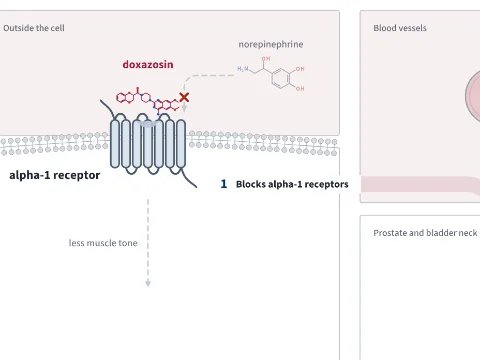
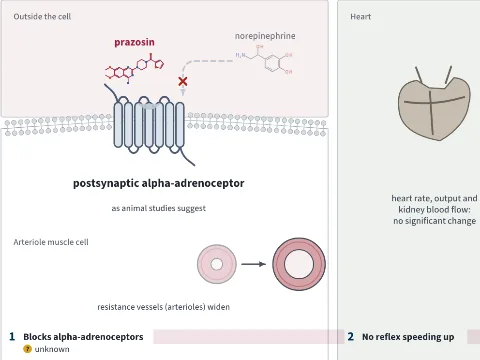
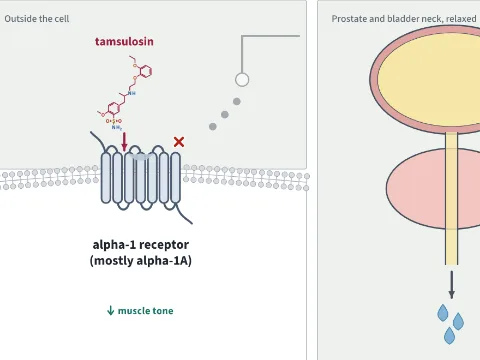
They block alpha-1 receptors on smooth muscle: in blood vessels this lowers resistance, and in the prostate and bladder neck it relaxes the muscle so urine flows more easily.
5 medicines in the Atlas share this action; 3 have a step-by-step page.
Step-by-step pages
Medicines in this class
| Medicine | Documented action | WHO ATC |
|---|---|---|
| Doxazosin step-by-step pageAdrenergic receptor alpha-1 antagonistAlso called Cardura | Adrenergic receptor alpha-1 antagonist | C02CA04 |
| Prazosin step-by-step pageAdrenergic receptor alpha-1 antagonist | Adrenergic receptor alpha-1 antagonist | C02CA01 |
| SilodosinAlpha-1a adrenergic receptor antagonist | Alpha-1a adrenergic receptor antagonist | G04CA04 |
| Tamsulosin step-by-step pageAdrenergic receptor alpha-1 antagonist | Adrenergic receptor alpha-1 antagonist | G04CA02 |
| TerazosinAdrenergic receptor alpha-1 antagonist | Adrenergic receptor alpha-1 antagonist | G04CA03 |
How this list is made
A medicine is listed when its ChEMBL mechanism-of-action record names one of these actions: “Adrenergic receptor alpha-1 antagonist” or “Alpha-1a adrenergic receptor antagonist”, and one of its WHO ATC codes is in C02CA or G04CA. “Withdrawn in some countries” comes from the ChEMBL withdrawn flag. Medicines are grouped by how they work; this is not a list of treatments or advice about which to use.
- ChEMBLMechanism-of-action records for each medicine (Atlas snapshot)
- WHO ATC classificationTherapeutic group codes used to narrow the list
Spotted a mistake? Report an error (hello@openmechanism.com). Since launch, every published error we fix is listed on the corrections page.