Pancrelipase
Pancrelipase is a mixture of enzymes from pig pancreas, released from enteric-coated pellets once the pH reaches about 5.5. In the duodenum and upper small intestine its lipases break fats into monoglycerides, glycerol and free fatty acids, its proteases break protein into peptides and amino acids, and its amylases break starch into dextrins and short sugars, as the pancreas's own enzymes would. In its trials, more fat was absorbed than with placebo.
- Acts on
- Dietary fats, proteins and starch
- Where
- The duodenum and upper small intestine
- Medicine type
- Enzyme
- Used for
- Digestion
Also called Zenpep.
How it works
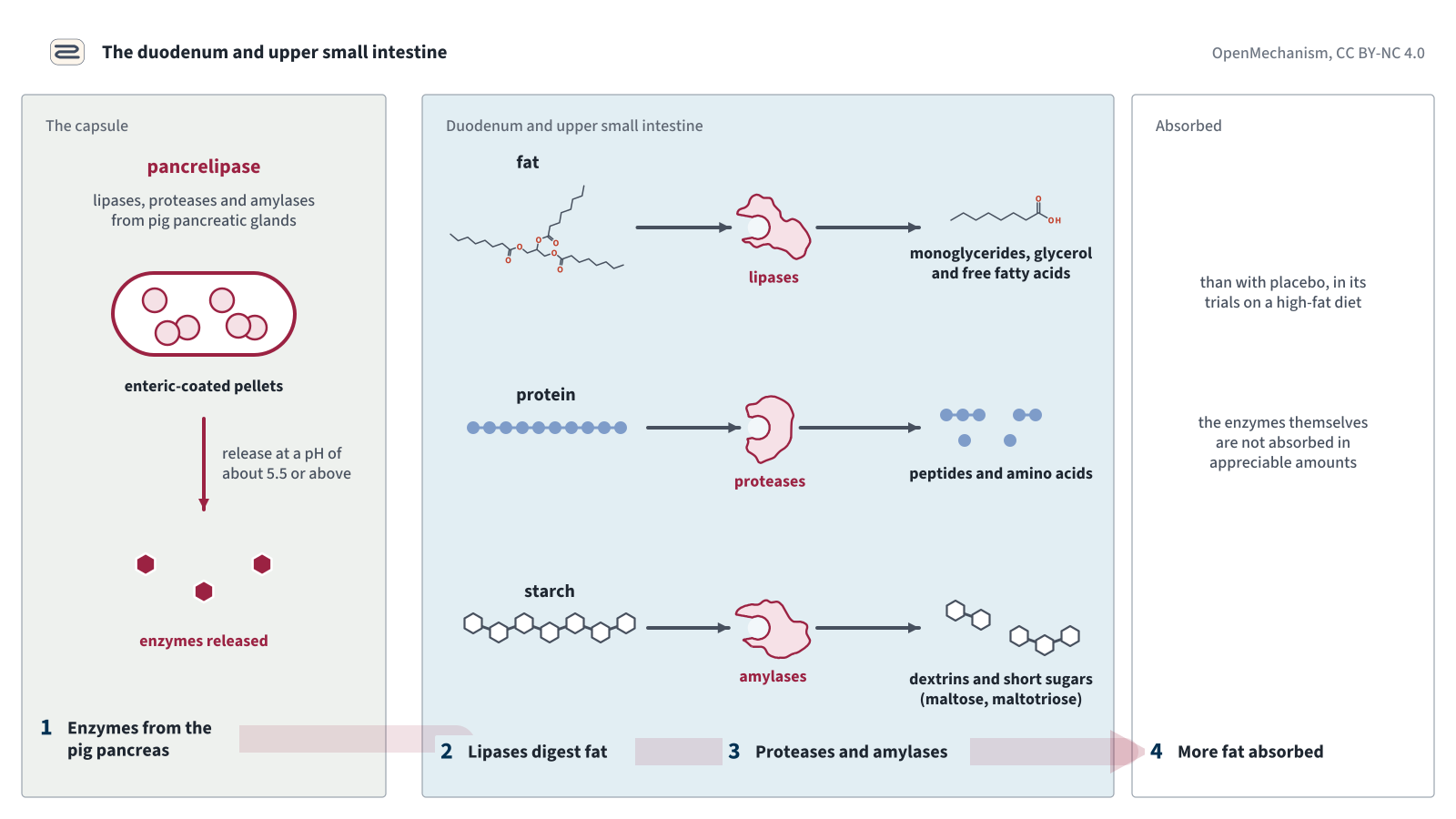
Enzymes from the pig pancreas. Pancrelipase is an extract of pig pancreatic glands: a mixture of enzymes including lipases, proteases and amylases, in enteric-coated pellets that release them at a pH of about 5.5 or above.1
Lipases digest fat. In the duodenum and upper small intestine, its lipases break fats down into monoglycerides, glycerol and free fatty acids.1
Proteases and amylases. Its proteases break protein into peptides and amino acids, and its amylases break starch into dextrins and short sugars such as maltose and maltotriose, acting like the digestive enzymes the pancreas secretes.1
More fat absorbed. In its clinical trials, on a high-fat diet, more fat was absorbed with the medicine than with placebo. The enzymes themselves are not absorbed from the gut in appreciable amounts.1
For teachers: download this drawing.
See also
Condition pages: cystic fibrosis.
Related drawings: orlistat (blocks the lipases that digest dietary fat).
Sources
- 1Zenpep (pancrelipase): FDA label1 Indications and Usage; 11 Description; 12 Clinical Pharmacology
- 2ChEMBL CHEMBL2108074Target and action classification: Fatty acids hydrolytic enzyme; Polypeptides hydrolytic enzyme; Starch hydrolytic enzyme
Also used for the drawing
The lipase, protease and amylase outlines are traced from the crystal structures below.
- 3Pig pancreatic lipase (from its complex with colipase); Ser153 marks the active sitePDB 1ETH; Hermoso, J. et al. J.Biol.Chem. 1996; 271:18007-18016
- 4Pig trypsin; His57 and Ser195 mark the active sitePDB 1S83; Transue, T.R. et al. Biochemistry 2004; 43:2829-2839
- 5Pig pancreatic alpha-amylase with an oligosaccharide (V-1532) in its active sitePDB 1PIG; Machius, M. et al. J.Mol.Biol. 1996; 260:409-421
Spotted a mistake? Report an error (hello@openmechanism.com). Since launch, every published error we fix is listed on the corrections page.
Notes and limits
- A schematic teaching drawing: not to scale, not exact structures, binding poses or a complete pathway, and not a guide to dosing, treatment or how a person will respond.
All recorded limits are on the evidence page, and notes that apply to every page are on How to read a page. Version 1.0.0, not yet medically reviewed.
Cite this page
Tran D. Pancrelipase [Internet]. OpenMechanism; 2026 [updated 2026 Oct 18; cited 2026 Oct 18]. Available from: https://openmechanism.com/medicines/pancrelipase