Neutrophil growth factors (G-CSF)
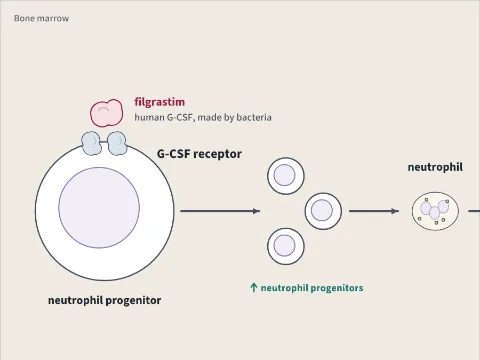
They act like the body's G-CSF: they bind its receptor on cells in the bone marrow, so more neutrophils are made, and they work better.
6 medicines in the Atlas share this action; 1 has a step-by-step page.
Step-by-step pages
Medicines in this class
| Medicine | Documented action | WHO ATC |
|---|---|---|
| Efbemalenograstim alfaGranulocyte colony stimulating factor receptor agonist | Granulocyte colony stimulating factor receptor agonist | L03AA18 |
| EflapegrastimGranulocyte colony stimulating factor receptor agonist | Granulocyte colony stimulating factor receptor agonist | L03AA19 |
| Filgrastim step-by-step pageGranulocyte colony stimulating factor receptor agonistAlso called Neupogen | Granulocyte colony stimulating factor receptor agonist | L03AA02 |
| LenograstimGranulocyte colony stimulating factor receptor agonist | Granulocyte colony stimulating factor receptor agonist | L03AA10 |
| LipegfilgrastimGranulocyte colony stimulating factor receptor agonist | Granulocyte colony stimulating factor receptor agonist | L03AA14 |
| PegfilgrastimGranulocyte colony stimulating factor receptor agonist | Granulocyte colony stimulating factor receptor agonist | L03AA13 |
How this list is made
A medicine is listed when its ChEMBL mechanism-of-action record names the action “Granulocyte colony stimulating factor receptor agonist”. “Withdrawn in some countries” comes from the ChEMBL withdrawn flag. Medicines are grouped by how they work; this is not a list of treatments or advice about which to use.
- ChEMBLMechanism-of-action records for each medicine (Atlas snapshot)
- WHO ATC classificationTherapeutic group codes used to narrow the list
Spotted a mistake? Report an error (hello@openmechanism.com). Since launch, every published error we fix is listed on the corrections page.