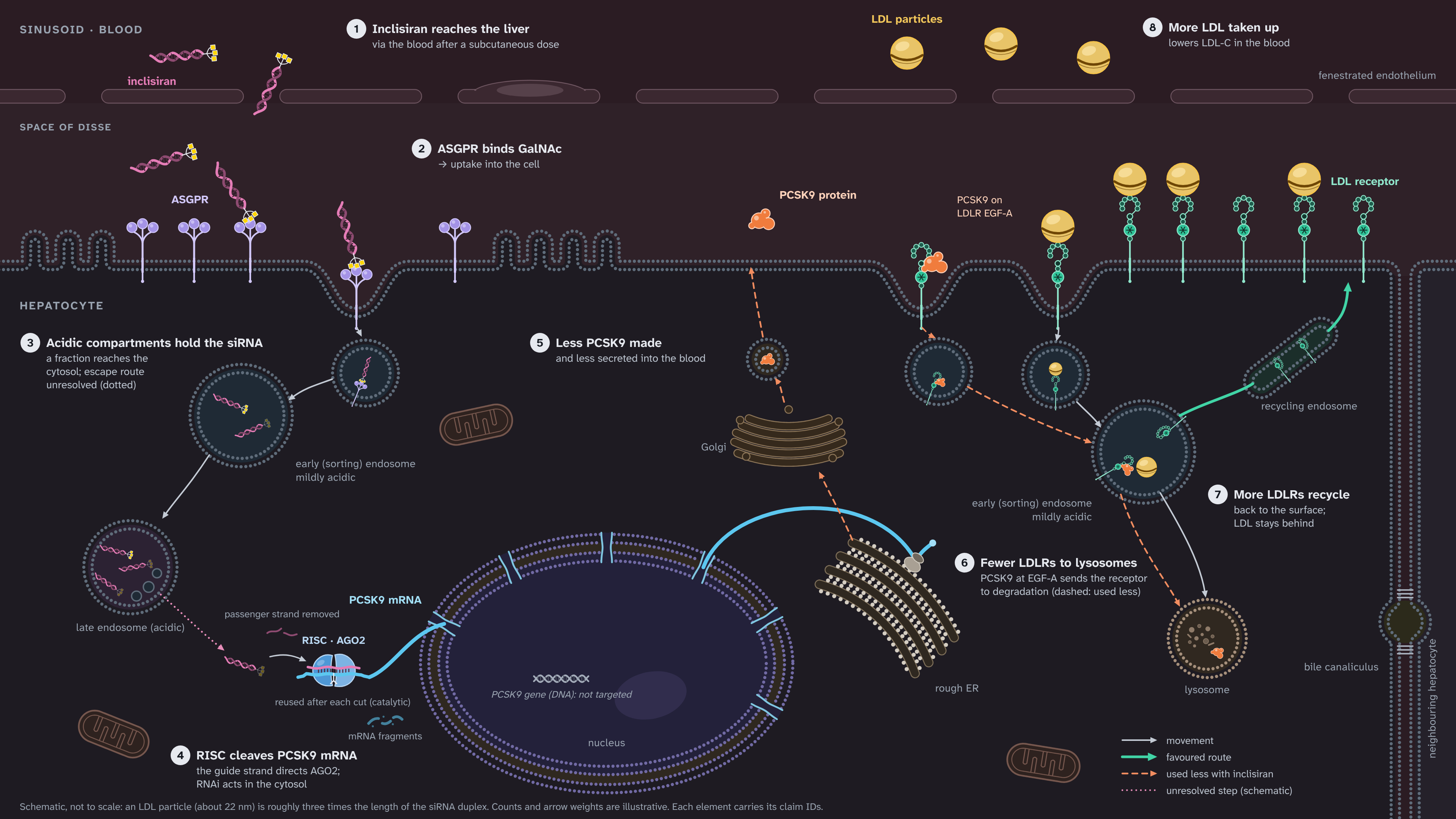
Figure · inclisiran@1.0.0
Inclisiran in a hepatocyte: from blood to LDL clearance
PRS_INCLISIRAN_HEPATOCYTE on Hepatocyte at the sinusoid
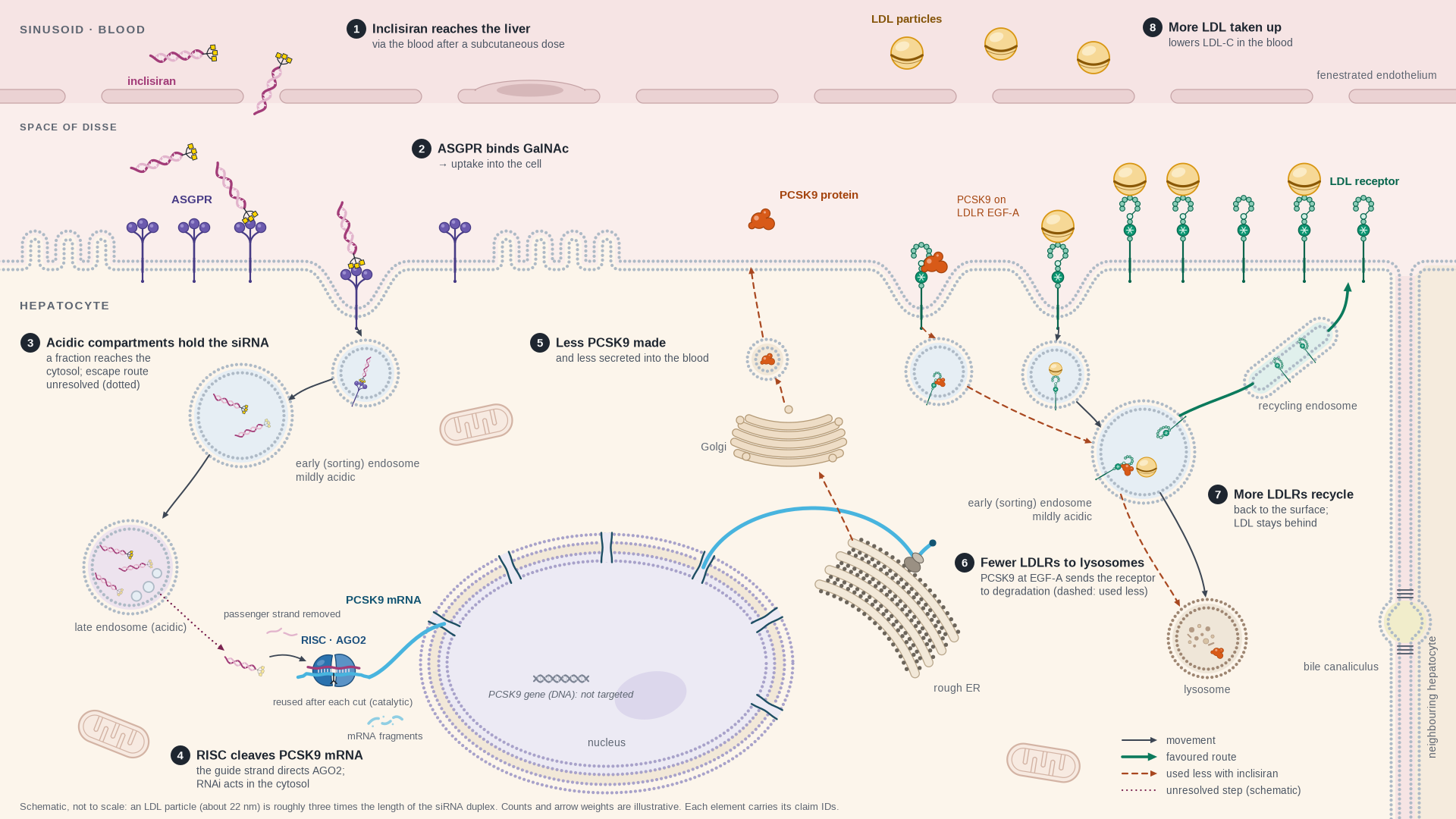
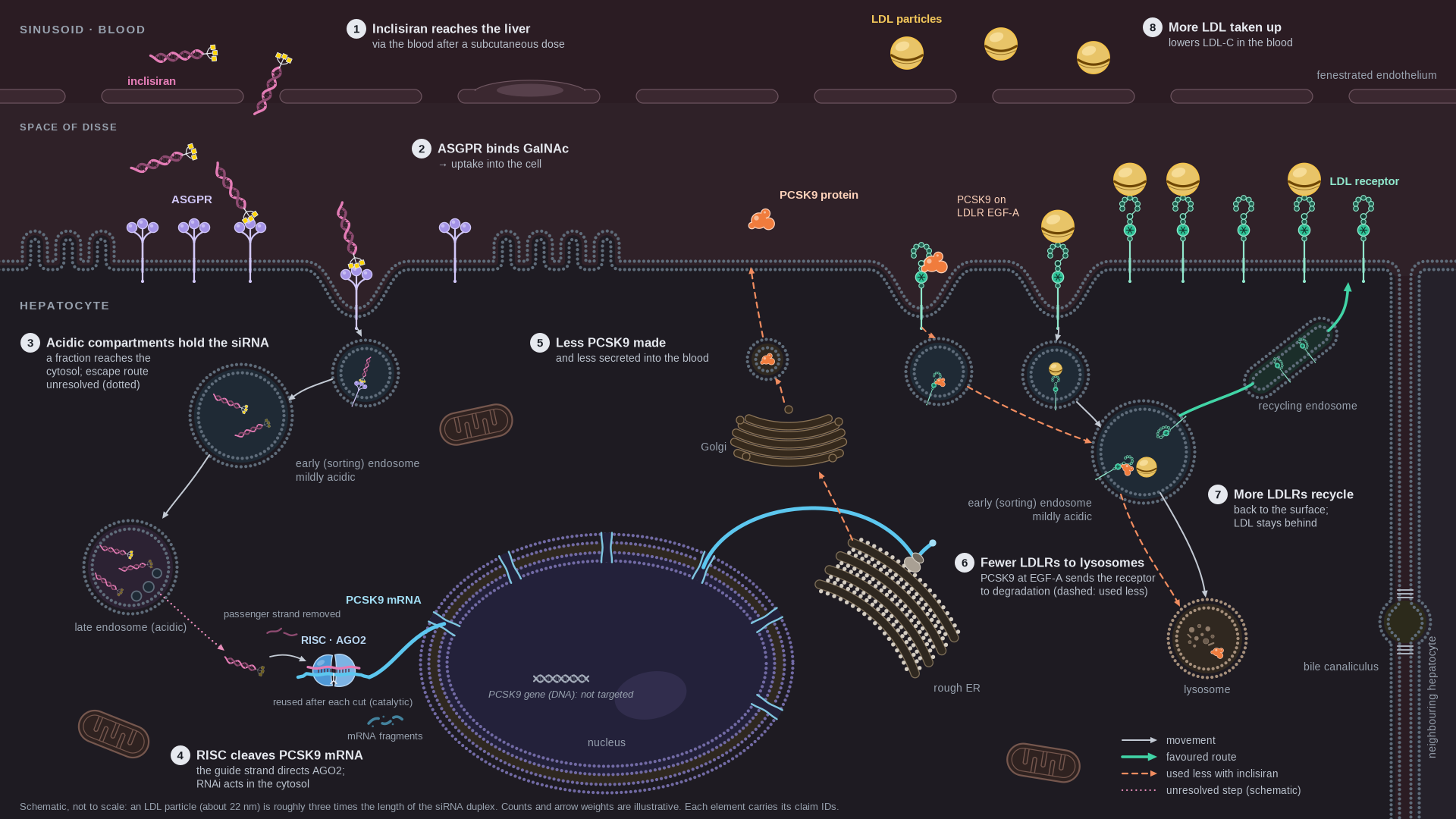
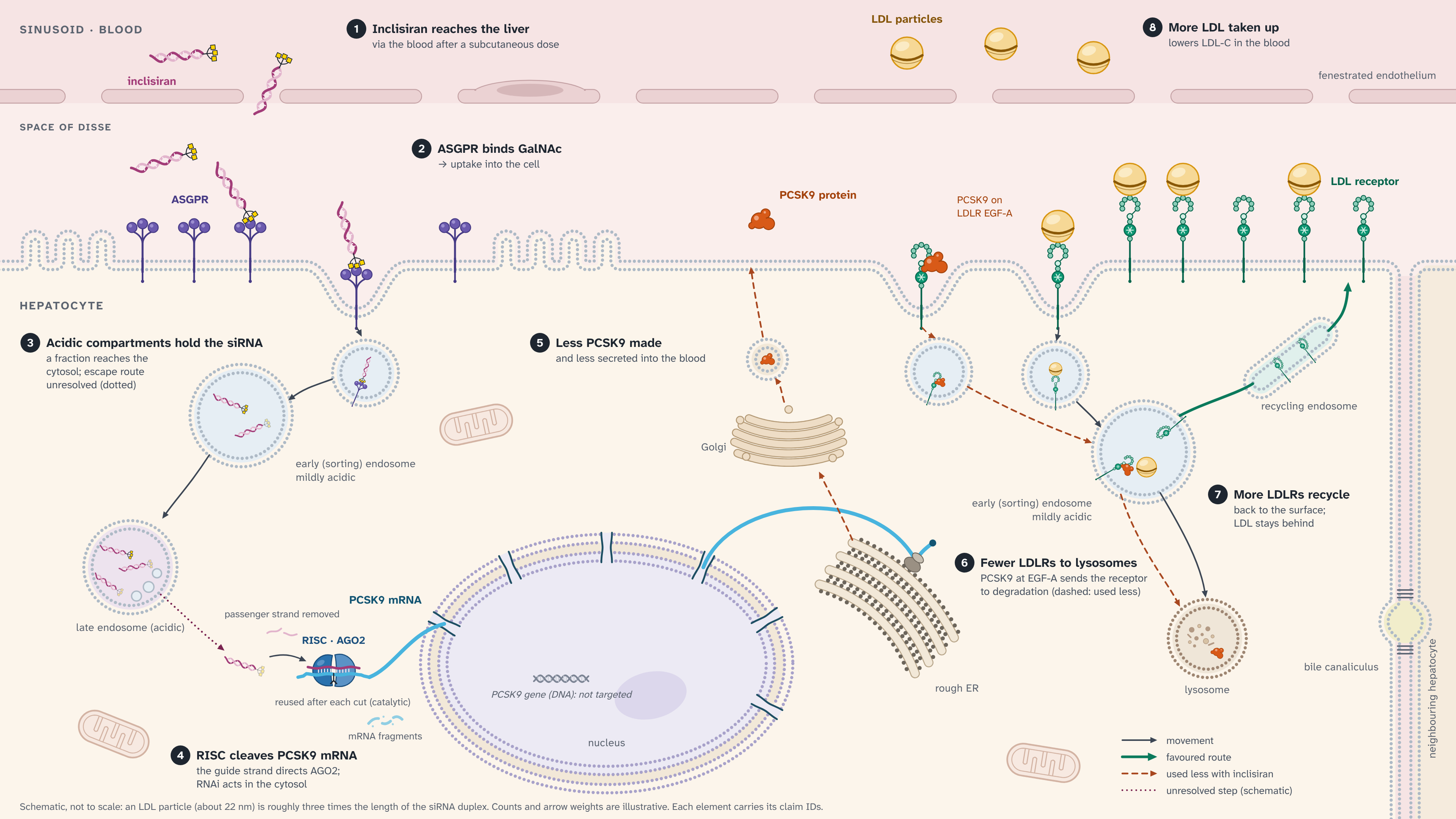
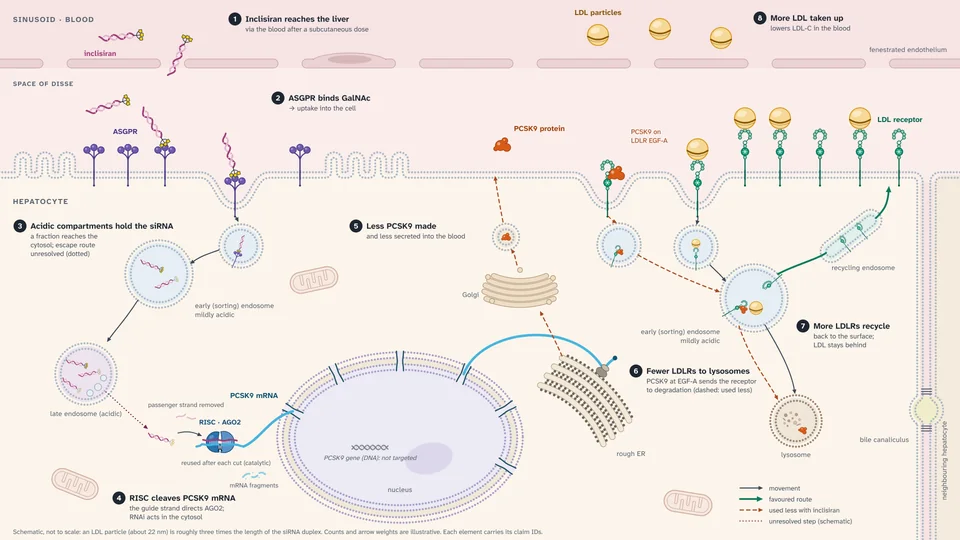
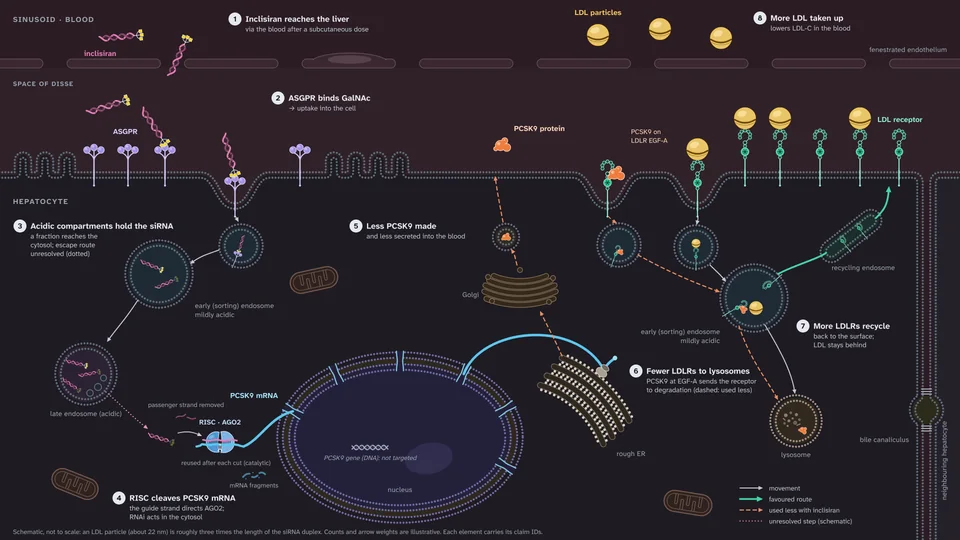
The eight steps of the inclisiran 1.0.0 mechanism composed from library symbols on the hepatocyte scene.
Loading the interactive version
movementfavoured routeroute used less with the drugunresolved step (schematic)
All steps
8 steps
Choose a step above, or select a numbered badge in the figure, to highlight the parts that belong to it.
Inspector
Select any part of the figure to see what it is, where it sits and the claims behind it.
Read the figure as text
The text equivalent from inclisiran@1.0.0.
- Inclisiran is a double-stranded siRNA whose sense strand carries a three-sugar GalNAc ligand; after subcutaneous injection it reaches the liver through the blood.
- On the hepatocyte surface, the GalNAc ligand binds the asialoglycoprotein receptor (ASGPR), and the conjugate is taken into the cell by endocytosis.
- The siRNA accumulates in acidic endosomal compartments that act as a depot; over time a fraction crosses into the cytosol. How it crosses the endosomal membrane is not known, so this step is drawn schematically.
- In the cytosol the antisense (guide) strand is loaded into Argonaute 2 (the RNA-induced silencing complex) while the passenger strand is removed. The guide pairs with PCSK9 mRNA and AGO2 cuts it; the complex can then act again. The PCSK9 gene itself is not changed.
- With fewer intact PCSK9 mRNA molecules, the cell makes and secretes less PCSK9 protein.
- Secreted PCSK9 normally binds the EGF-A region of LDL receptors and, after uptake, holds them in a form that is sent to lysosomes and degraded. With less PCSK9, fewer receptors take that route.
- More LDL receptors release their LDL in the acidic endosome and recycle to the cell surface.
- More surface receptors bind and internalize LDL particles; the LDL itself is degraded in lysosomes. The result is lower LDL cholesterol in the blood.
Parts
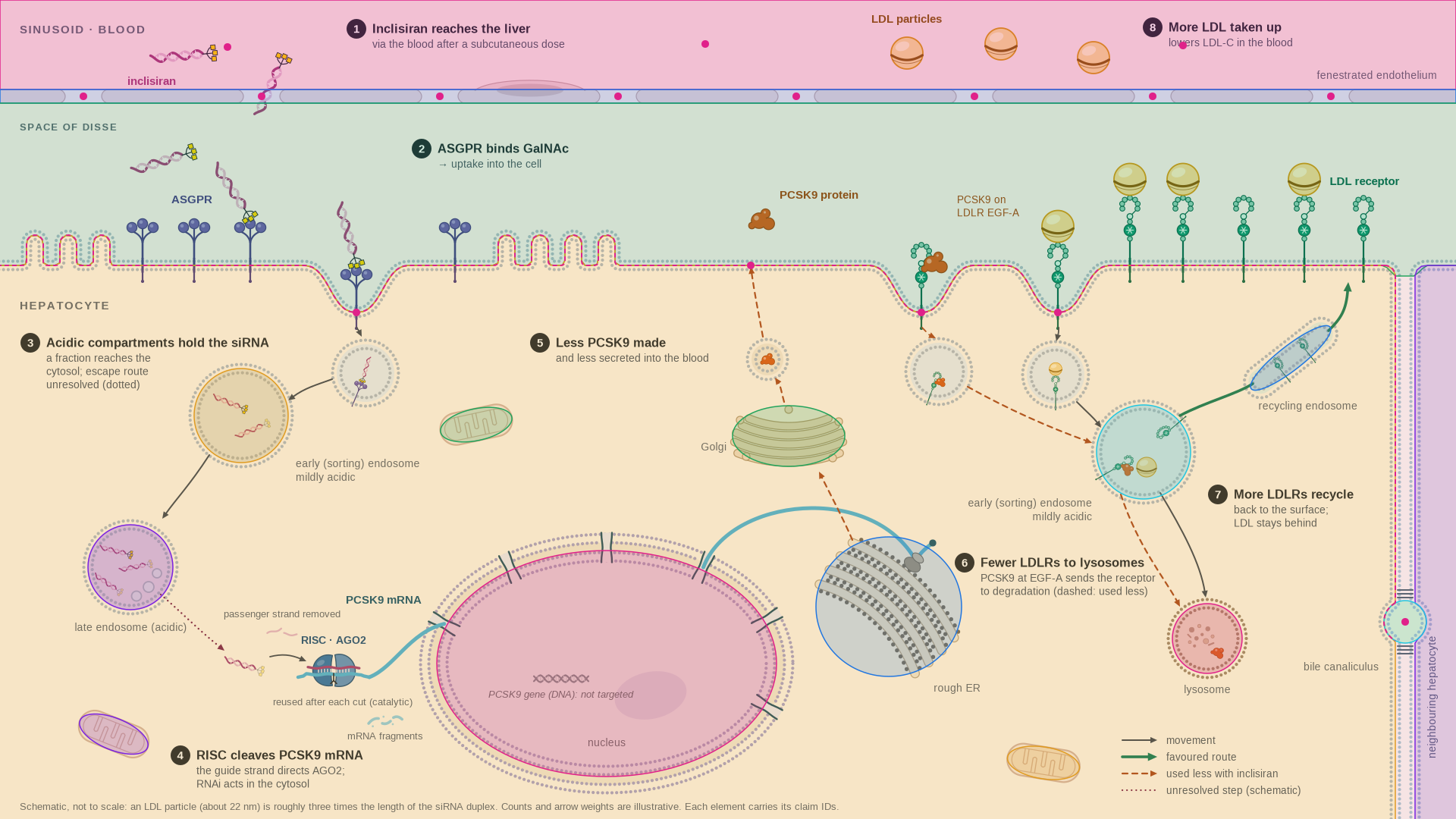
56 symbol instances, 3 strands and 20 arrows, each tagged with the claims behind it.
All 59 parts
Review checks
What this figure was checked for before release.
- Every LDL-carrying vesicle includes its LDL receptor (fixes the 1.0.0 review note on styles C/D).
- Membrane proteins are mounted on the bilayer mid-plane with a visible transmembrane segment.
- LDL goes to the lysosome; only the receptor recycles (C20).
- PCSK9 is bound at EGF-A and never shown cutting the receptor (C16).
- Endosomal escape is a dotted crossing with no pore (C08).
- GalNAc is shown faded from the acidic compartments onward; the site of sugar loss is not drawn (C22).
Files
Use the PNG in slides and the SVG on the web.