Hypertrophic cardiomyopathy
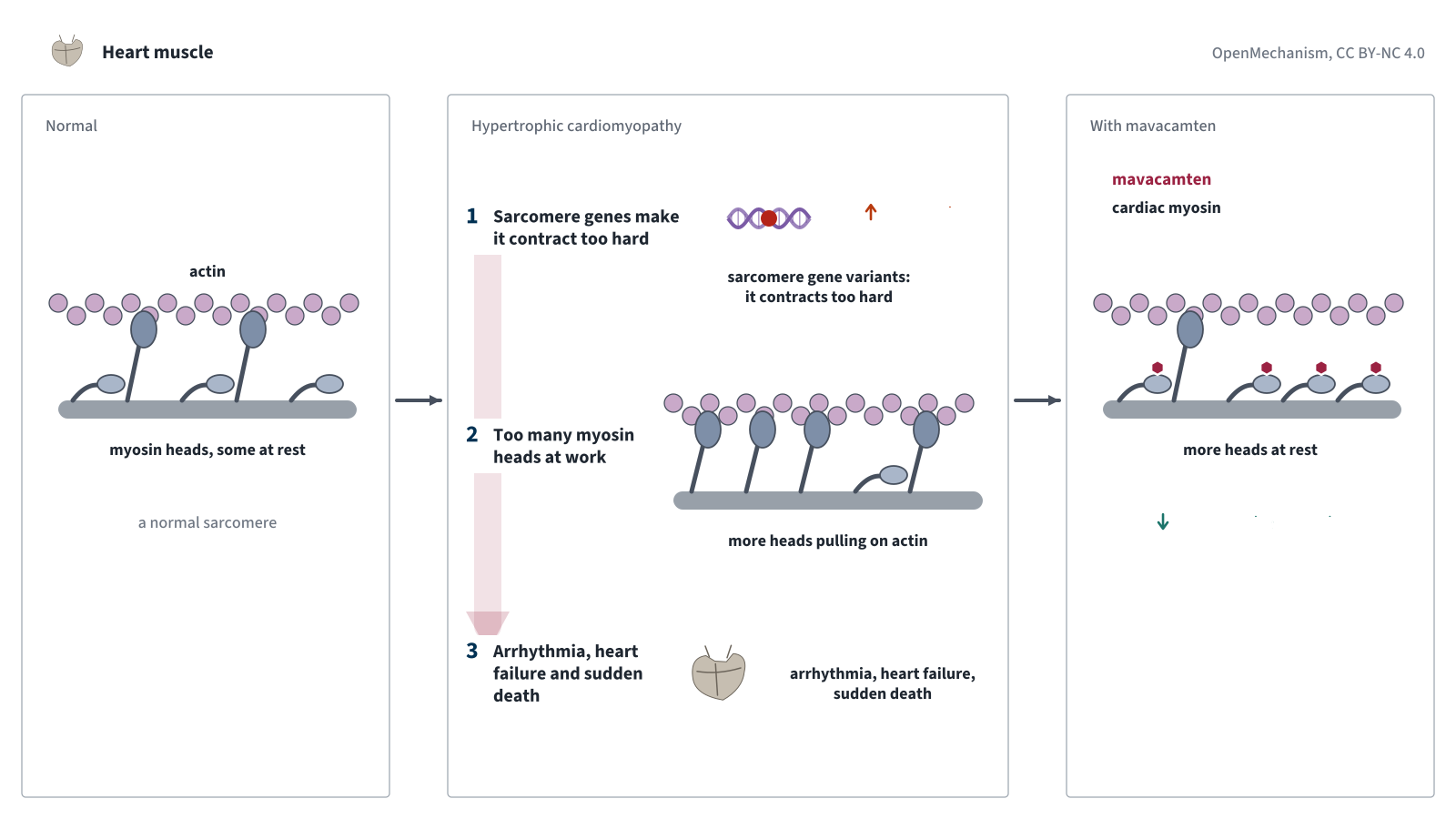
Hypertrophic cardiomyopathy affects more than 1 in 500 people and can cause arrhythmia, heart failure and sudden death. The leading explanation is that gene variants make the sarcomere contract too hard, with too many myosin heads free to bind actin. The heart muscle thickens, in the obstructive form blocking the blood's way out. Mavacamten puts more myosin heads to rest.
- Where
- Heart muscle
- Body systems
- Heart, vessels & cholesterol; Muscles, bones & joints
- Medicines
- 1 medicine
For teachers: download this drawing.
What goes wrong
Sarcomere genes make it contract too hard. The leading explanation is that disease-causing variants in sarcomere proteins make the sarcomere contract too hard (hypercontractility).1
What the source says
“The overarching hypothesis is that HCM-causing mutations in sarcomere proteins cause hypercontractility at the sarcomere level”
Source 1Too many myosin heads at work. More myosin heads are free to bind actin; excess myosin-actin cross-bridges and a disturbed resting (super-relaxed) state are hallmarks of the disease.1,2
Arrhythmia, heart failure and sudden death. Hypertrophic cardiomyopathy affects more than 1 in 500 people and causes arrhythmia, heart failure and sudden death.1
What the source says
“Hypertrophic cardiomyopathy (HCM) affects more than 1 in 500 people in the general population with an extensive burden of morbidity in the form of arrhythmia, heart failure, and sudden death.”
Source 1
Where medicines act
- A
Mavacamten: more myosin heads at rest
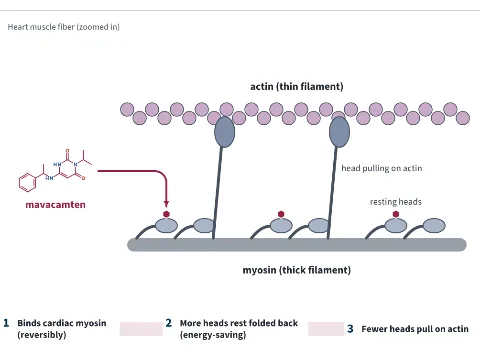
Mavacamten, a reversible inhibitor of cardiac myosin, lets fewer myosin heads enter the force-producing state; it treats symptomatic obstructive hypertrophic cardiomyopathy.2
What the source says
“Mavacamten is an allosteric and reversible inhibitor selective for cardiac myosin.”
Source 2“Mavacamten modulates the number of myosin heads that can enter “on actin” (power-generating) states”
Source 2“CAMZYOS is indicated for the treatment of adults and pediatric patients weighing 30 kg or more with symptomatic obstructive hypertrophic cardiomyopathy (HCM) to improve functional capacity and symptoms.”
Source 2
See also
Body systems: heart, vessels & cholesterol; and muscles, bones & joints.
Sources
- 1Hypertrophic cardiomyopathy: mutations to mechanisms to therapiesKawana M et al. Front Physiol 2022 (abstract). Saved copy
- 2Camzyos (mavacamten): FDA label1 Indications and Usage; 12.1 Mechanism of Action. Saved copy
Notes and limits
- That sarcomere variants cause the disease through hypercontractility is the researchers' overarching hypothesis.1
Notes that apply to every page are on How to read a page.
Spotted a mistake? Report an error (hello@openmechanism.com). Since launch, every published error we fix is listed on the corrections page.
Cite this page
Tran D. Hypertrophic cardiomyopathy [Internet]. OpenMechanism; 2026 [updated 2026 Oct 17; cited 2026 Oct 17]. Available from: https://openmechanism.com/conditions/hypertrophic-cardiomyopathy