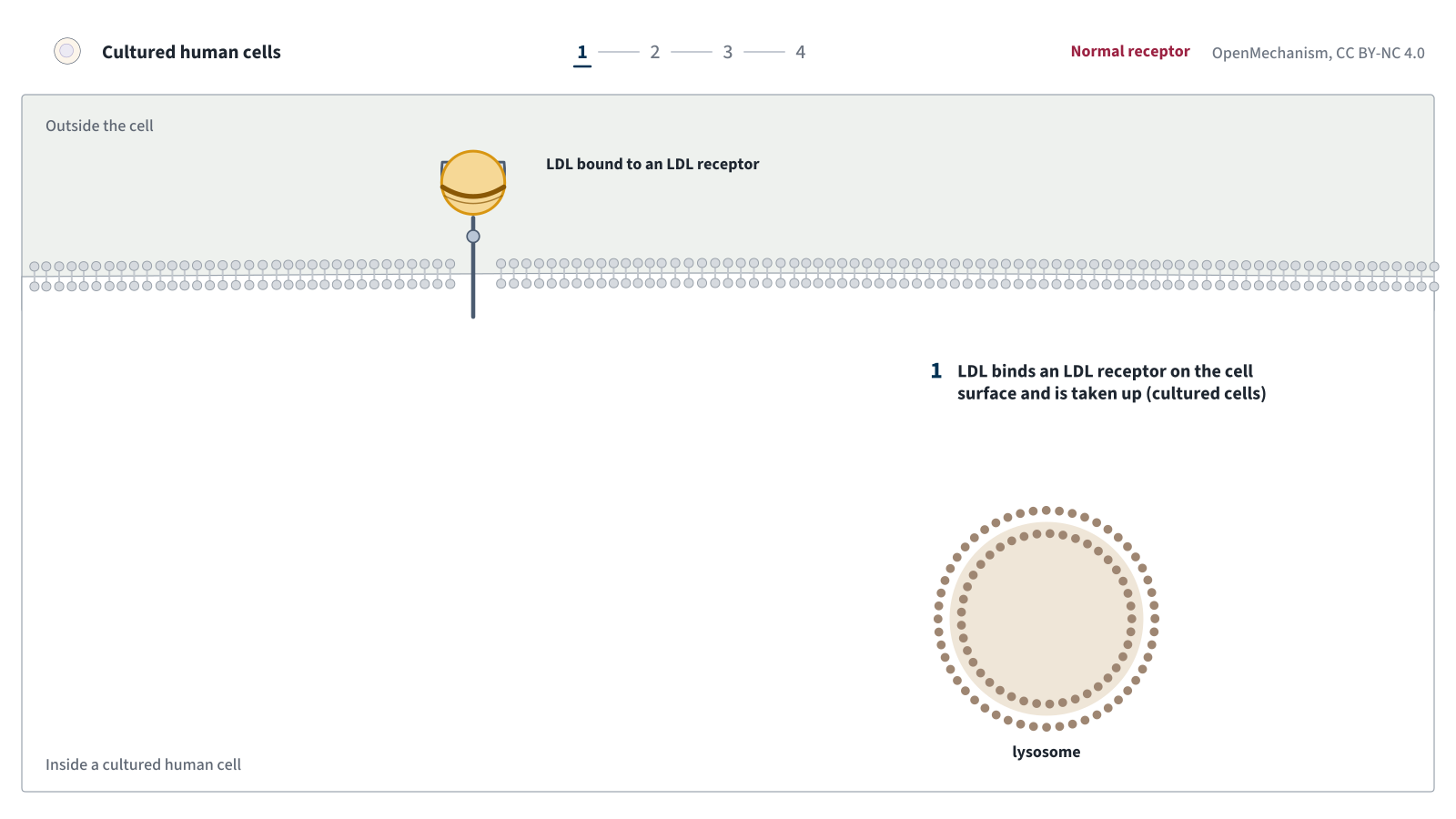
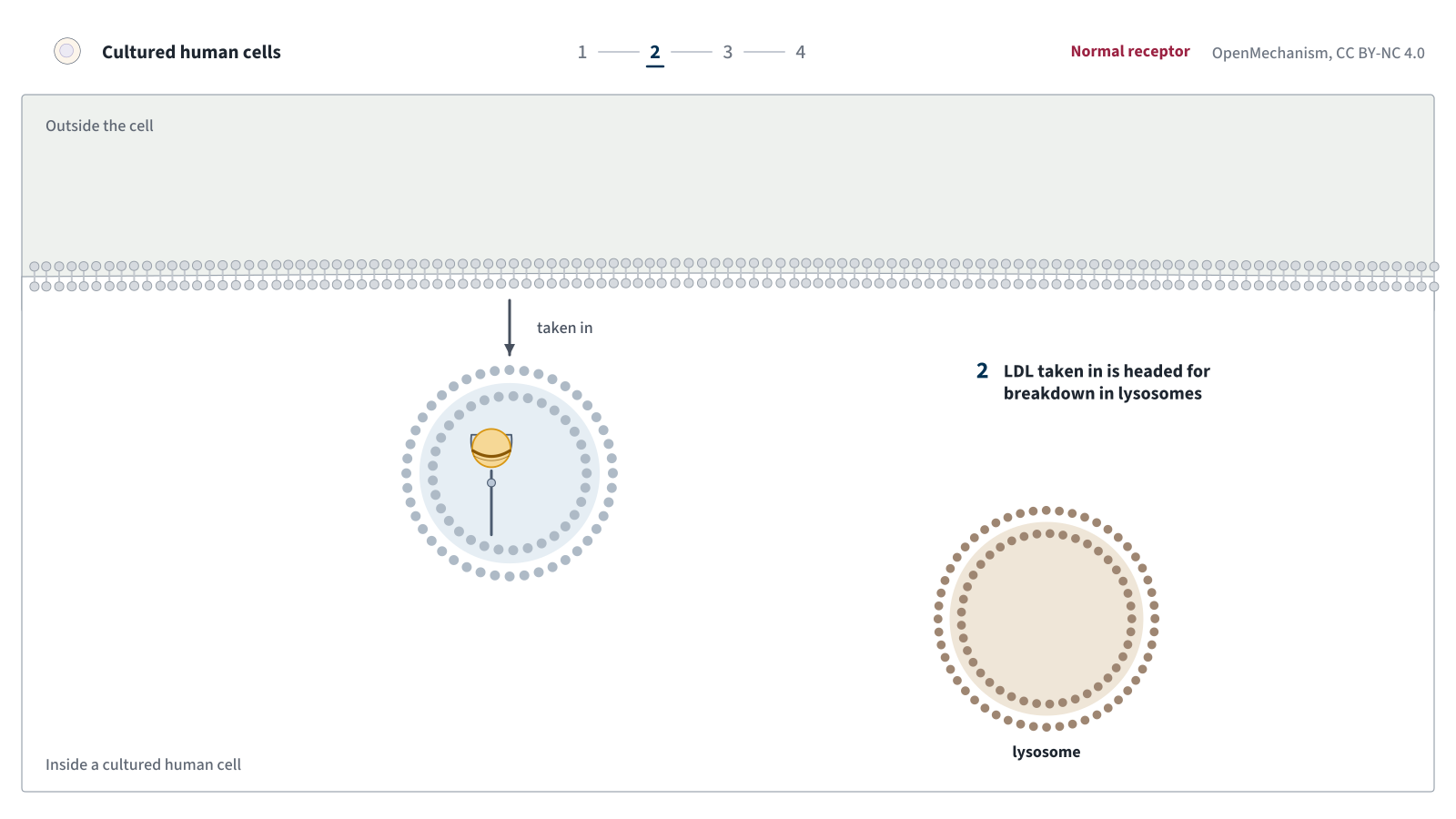
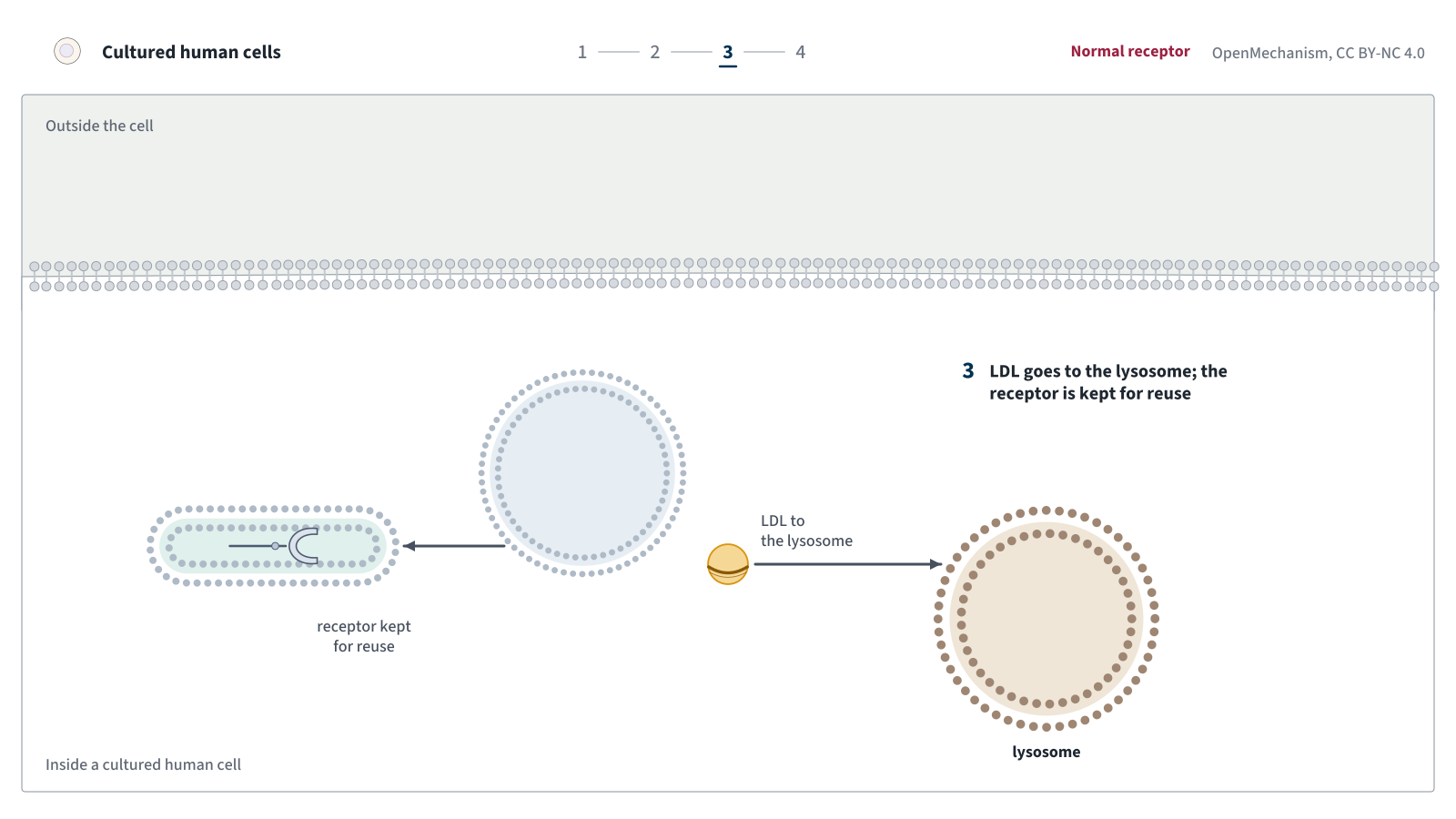
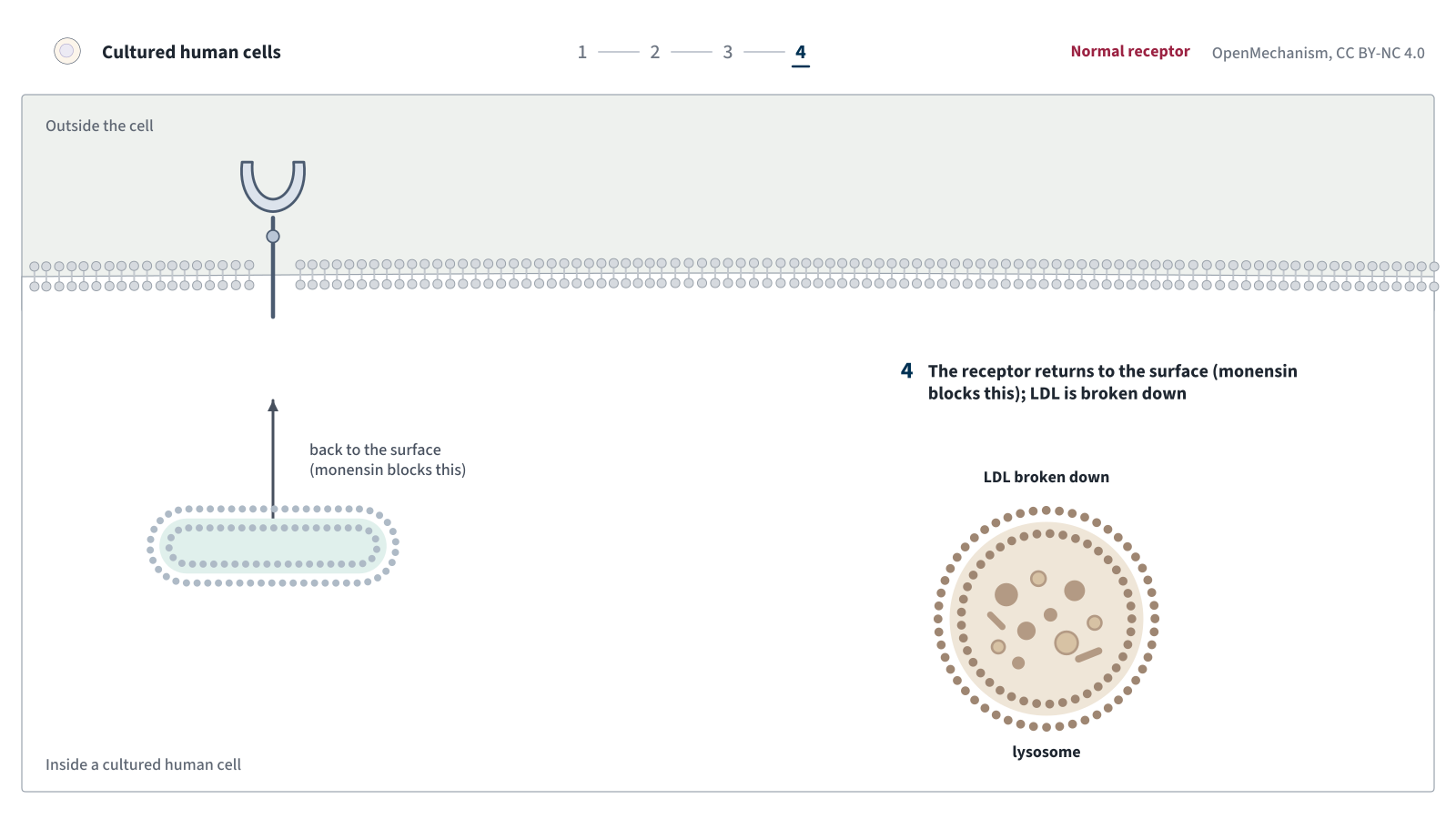
What happens to LDL and its receptor inside the cell
What happens to LDL and its receptor after binding, in laboratory experiments on cultured human cells: the LDL is broken down and the receptor is used again.
A schematic teaching drawing: not to scale, not exact structures, binding poses or a complete pathway, and not a guide to dosing, treatment or how a person will respond.
The steps are in the order that explains them; one step is said to cause the next only where the source says so.
Cultured human fibroblast experiment, not a measured trajectory or universal hepatocyte kinetics model.
Full article not inspected; no rate, particle count, lifetime or clinical effect taken from the abstract.
Human fibroblast / monensin experimental context retained. The normal illustration shows reutilization, not monensin treatment.
Direct page challenge and unverified full text are explicit access limits. No numerical recycling kinetics or percentages used.
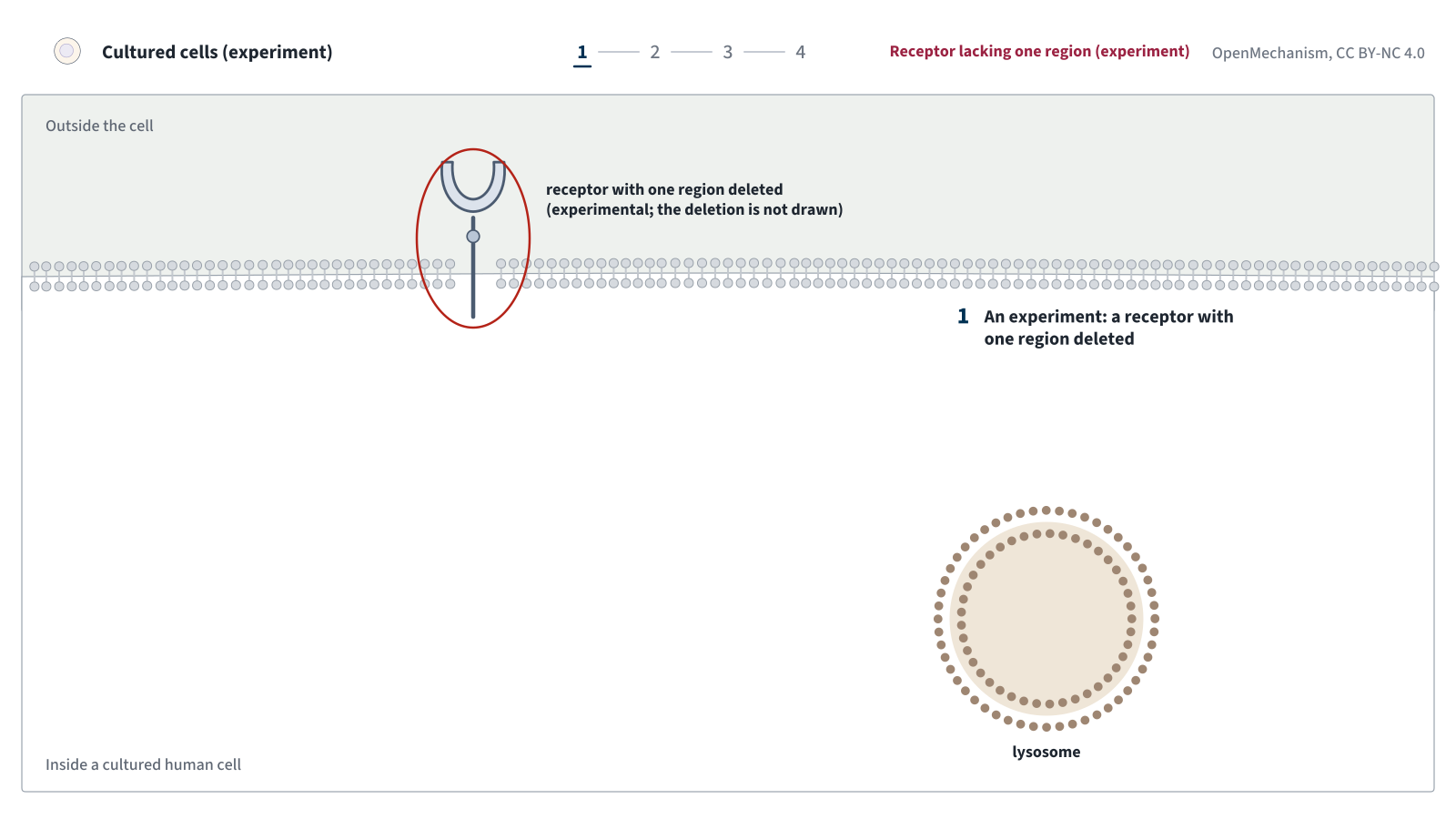
Engineered deletion experiment; inspected abstract does not establish the exact cell/species context or a resolved conformation.
No numerical acid-pH threshold, domain deletion geometry, degradation time or universal wild-type itinerary inferred.
Primary receptor-cycle observations and mutation experiment are separate source contexts, not drug-specific new claims.
Normal route is a composite explanation of cultured human fibroblast observations. LDL lysosomal degradation is distinct from receptor reutilization/return to the surface.
The domain-deletion mode preserves its engineered experimental context. No universal pH value, exact receptor fold or endogenous mutant geometry is inferred.
The drawings are schematic and not to scale; each step shows only what its statements say, and the time between steps is not a measured time. They replace the record player's views, which stay available: original record animation.
Every limit as recorded
Player duration and motion are explanatory, not measured biological kinetics.
Cultured human fibroblast experiment, not a measured trajectory or universal hepatocyte kinetics model.
Full article not inspected; no rate, particle count, lifetime or clinical effect taken from the abstract.
Cultured human fibroblasts
Human fibroblast / monensin experimental context retained. The normal illustration shows reutilization, not monensin treatment.
Direct page challenge and unverified full text are explicit access limits. No numerical recycling kinetics or percentages used.
Engineered deletion experiment; inspected abstract does not establish the exact cell/species context or a resolved conformation.
No numerical acid-pH threshold, domain deletion geometry, degradation time or universal wild-type itinerary inferred.
Engineered LDLR domain-deletion experiment; cell/species details not established by inspected abstract.
Source-backed motion explanation.
Timing, particle counts, paths, spacing and geometry are illustrative; no measured rates, distances, concentrations or clinical response implied.
Original 2D glyphs and class icons are schematic references, not molecular folds, binding poses or to-scale anatomy.
Motion and cue order are an authored explanatory layer. Only declared, separately source-bound relations carry biological meaning.
Manual playback / seek / replay; no autoplay. A still frame alone does not imply the entire process happened at one time.
Primary receptor-cycle observations and mutation experiment are separate source contexts, not drug-specific new claims.
Normal route is a composite explanation of cultured human fibroblast observations. LDL lysosomal degradation is distinct from receptor reutilization/return to the surface.
The domain-deletion mode preserves its engineered experimental context. No universal pH value, exact receptor fold or endogenous mutant geometry is inferred.
The record's notes on each step
Normal receptor, step 1: Surface LDL receptor binding initiates LDL uptake in cultured human fibroblasts.
Normal receptor, step 2: LDL cargo is internalized for lysosomal degradation; no vesicle fusion, pH or sorting geometry is supplied.
Normal receptor, step 3: The illustration separates LDL-cargo degradation from receptor reutilization; this is a composite explanation, not an observed route.
Normal receptor, step 4: The receptor returns toward a surface reference while LDL follows a distinct lysosomal-degradation context. Monensin blocks receptor return in the source experiment.
Receptor lacking one region (experiment), step 1: A growth-factor-homology-domain deletion is an experimental condition. The card does not draw or resolve the deletion.
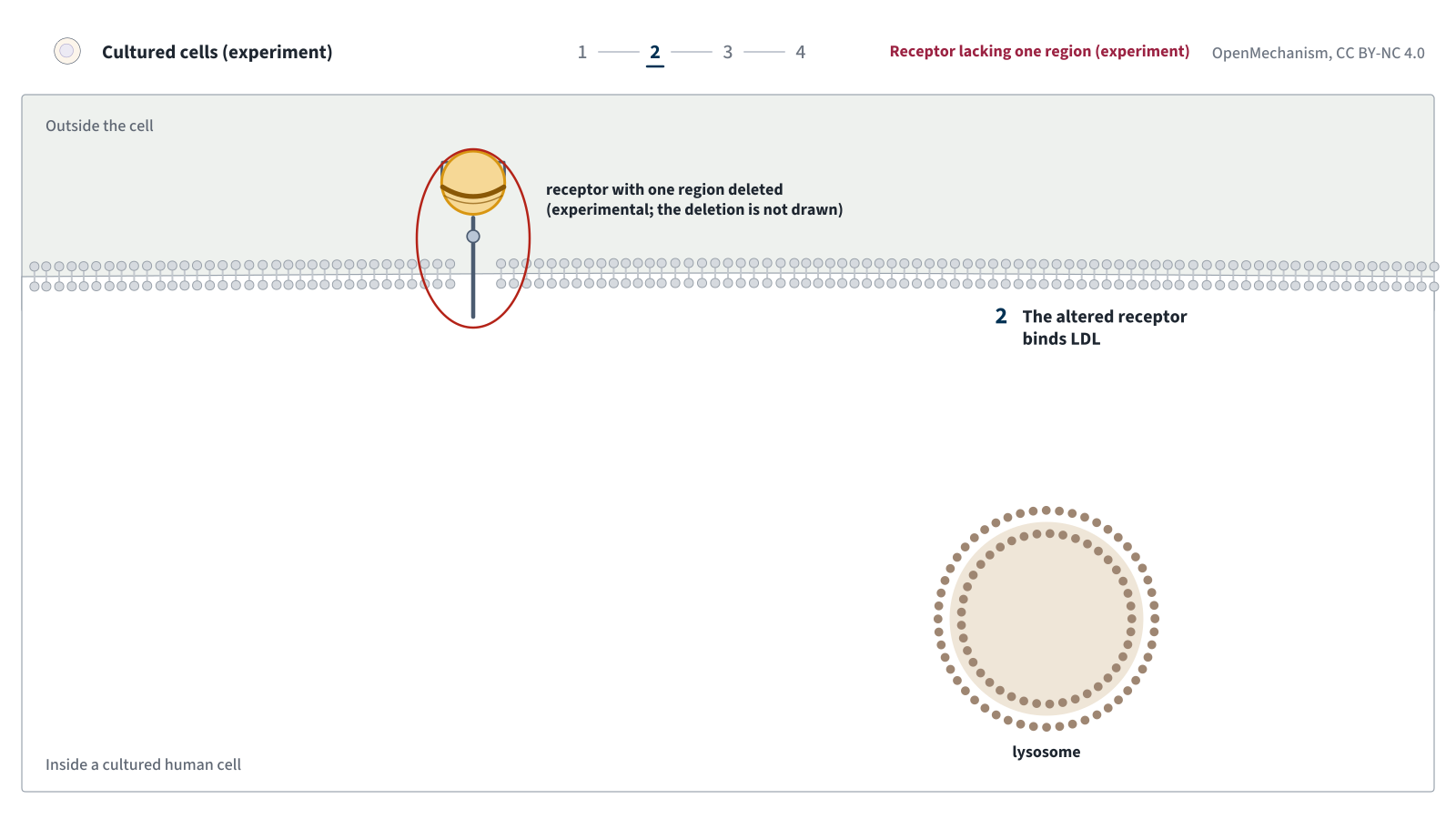
Receptor lacking one region (experiment), step 2: The experiment concerns a receptor lacking the selected region; no universal normal receptor route is inferred.
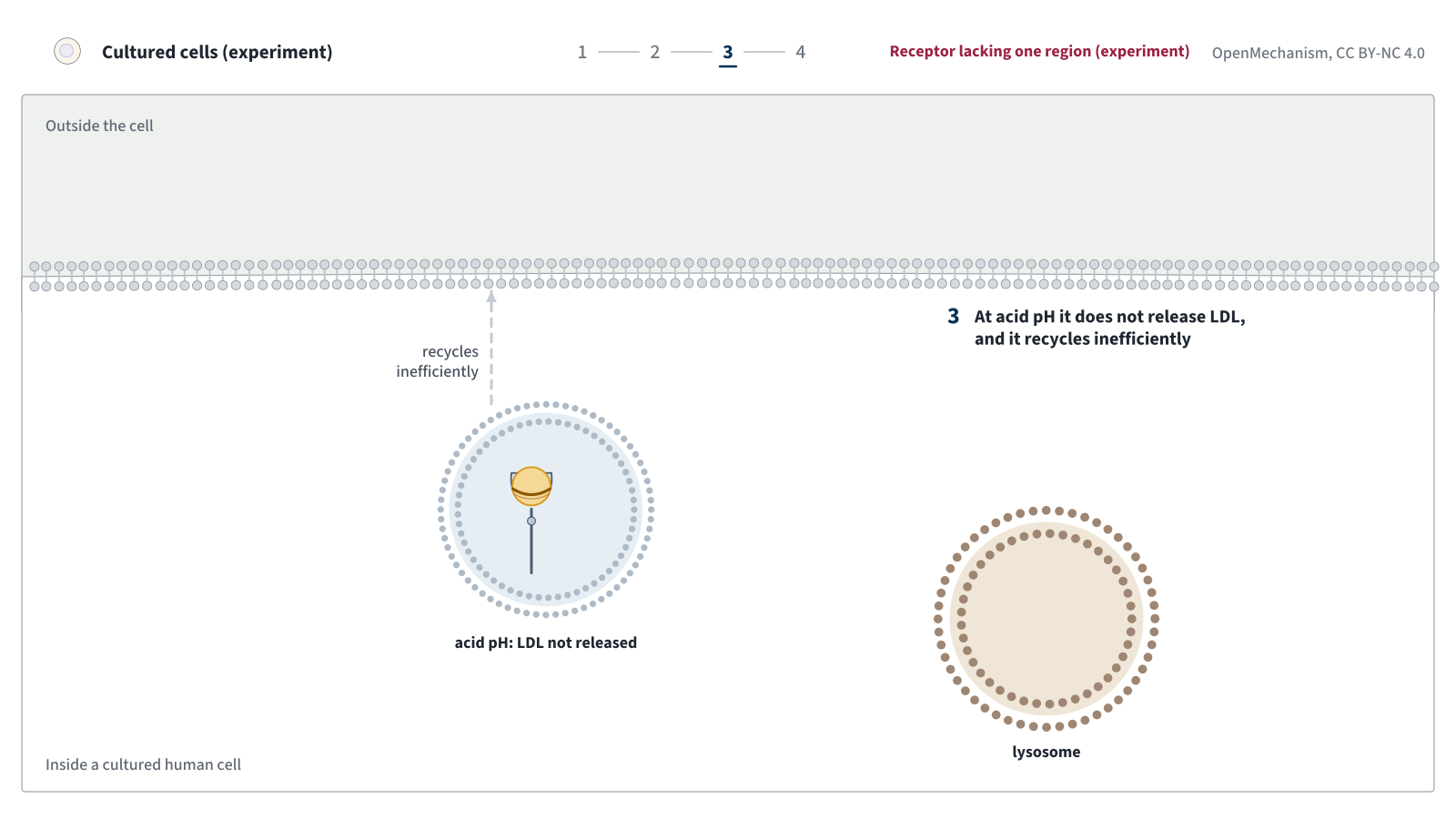
Receptor lacking one region (experiment), step 3: The domain-deleted receptor no longer released ligand at acid pH and recycled inefficiently.
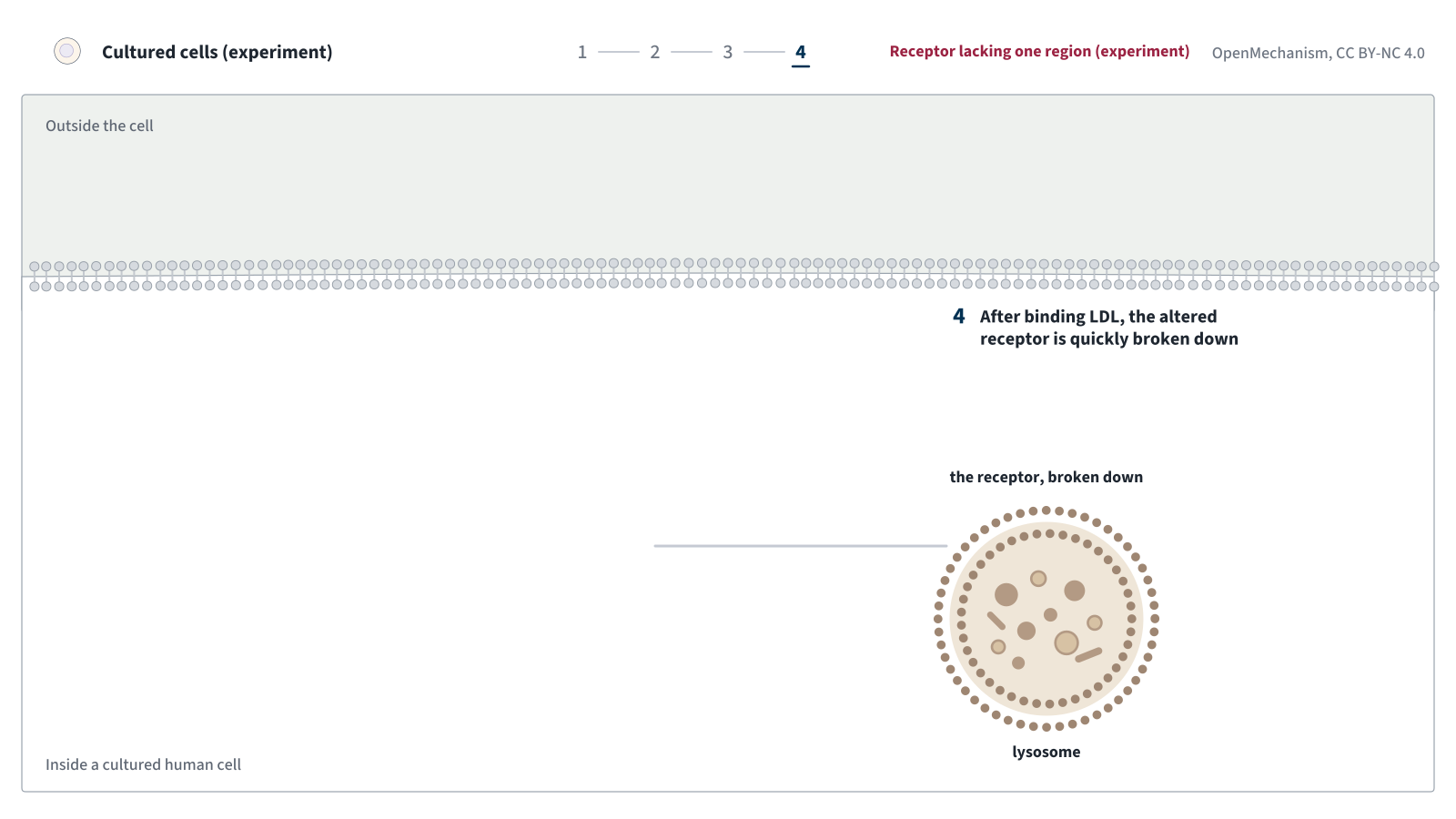
Receptor lacking one region (experiment), step 4: The abstract reports degradation after ligand binding. The player cue time is not its biological degradation time.
Tran D. What happens to LDL and its receptor inside the cell [Internet]. OpenMechanism; 2026 [updated 2026 Oct 18; cited 2026 Oct 18]. Available from: https://openmechanism.com/animations/ldlr-recycling