A schematic teaching drawing: not to scale, not exact structures, binding poses or a complete pathway, and not a guide to dosing, treatment or how a person will respond.
The steps are in the order that explains them; one step is said to cause the next only where the source says so.
RNA target; not direct binding to secreted PCSK9 protein.
Qualitative statement restricted to the linked source context.
Qualitative LDL-C outcome; no individual response magnitude or event reduction inferred.
PCSK9 RNA and protein remain distinct.
No direct cardiovascular outcome benefit is inferred from LDL-C lowering or from other PCSK9 medicines.
ASGPR binding, endosomal escape and AGO2 geometry are outside the selected label evidence.
This process begins at qualified intracellular RNA interference. It does not add AGO2 identity, endosomal escape, pH, RISC geometry or guide–target base pairing.
The drawings are schematic and not to scale; each step shows only what its statements say, and the time between steps is not a measured time. They replace the record player's views, which stay available: original record animation.
Every limit as recorded
Player duration and motion are explanatory, not measured biological kinetics.
RNA target; not direct binding to secreted PCSK9 protein.
human-medicine label description; not a resolved molecular pose
Qualitative statement restricted to the linked source context.
Qualitative LDL-C outcome; no individual response magnitude or event reduction inferred.
Source-backed motion explanation.
Timing, particle counts, paths, spacing and geometry are illustrative; no measured rates, distances, concentrations or clinical response implied.
Original 2D glyphs and class icons are schematic references, not molecular folds, binding poses or to-scale anatomy.
Motion and cue order are an authored explanatory layer. Only declared, separately source-bound relations carry biological meaning.
Manual playback / seek / replay; no autoplay. A still frame alone does not imply the entire process happened at one time.
Qualitative, source-bound teaching figure; no kinetics, response prediction or treatment guidance.
Abstract actors and compartment labels; no inferred binding pose, molecular coordinates or escape efficiency.
PCSK9 RNA and protein remain distinct.
No direct cardiovascular outcome benefit is inferred from LDL-C lowering or from other PCSK9 medicines.
ASGPR binding, endosomal escape and AGO2 geometry are outside the selected label evidence.
This process begins at qualified intracellular RNA interference. It does not add AGO2 identity, endosomal escape, pH, RISC geometry or guide–target base pairing.
Original guide/PCSK9 RNA drawings are source representations. Fragment shapes, numbers and cleavage positions are not experimentally resolved here.
The record's notes on each step
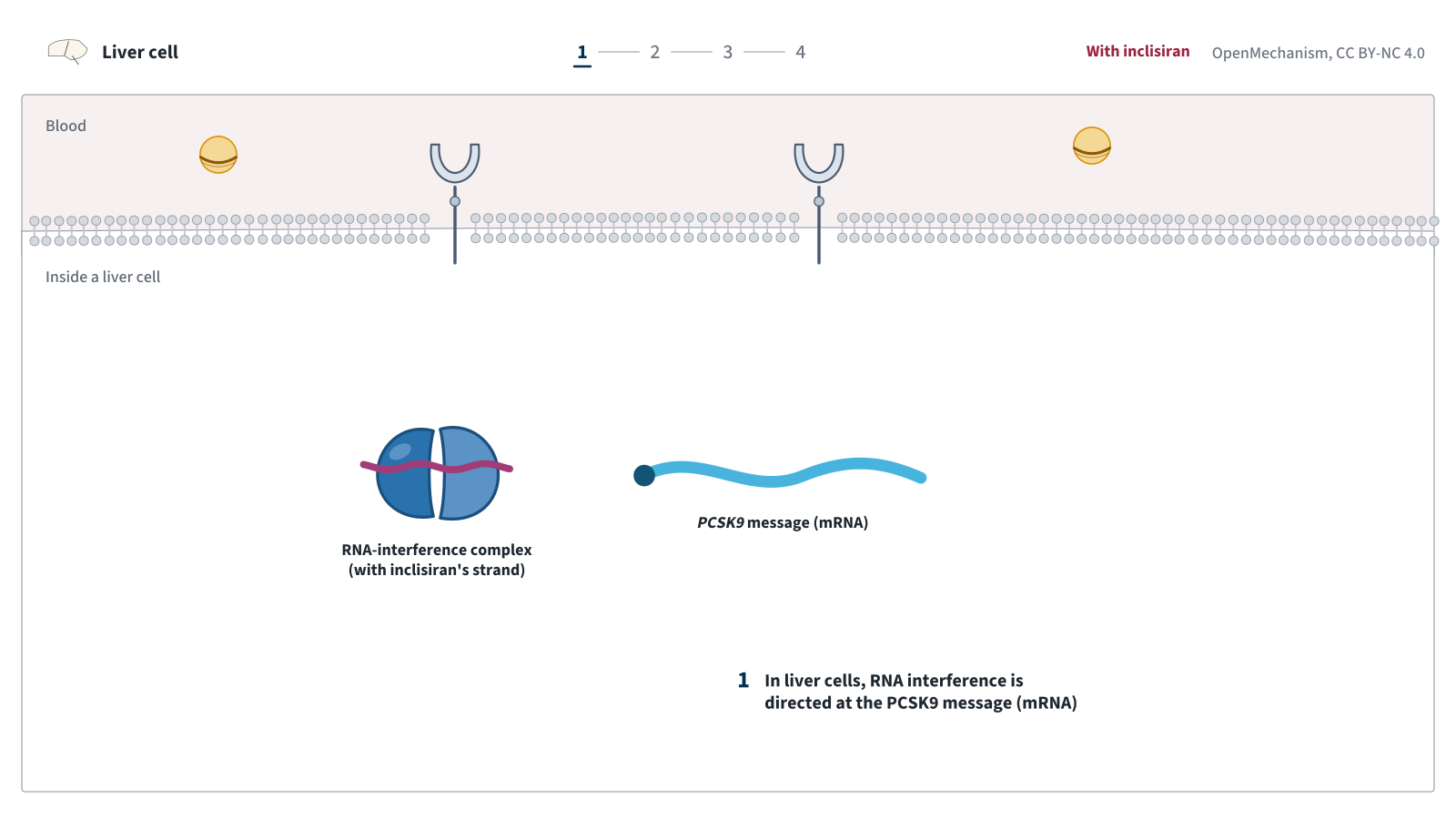
Step 1: The selected label describes hepatocyte RNA interference directed at PCSK9 mRNA. Upstream delivery details are outside this animation.
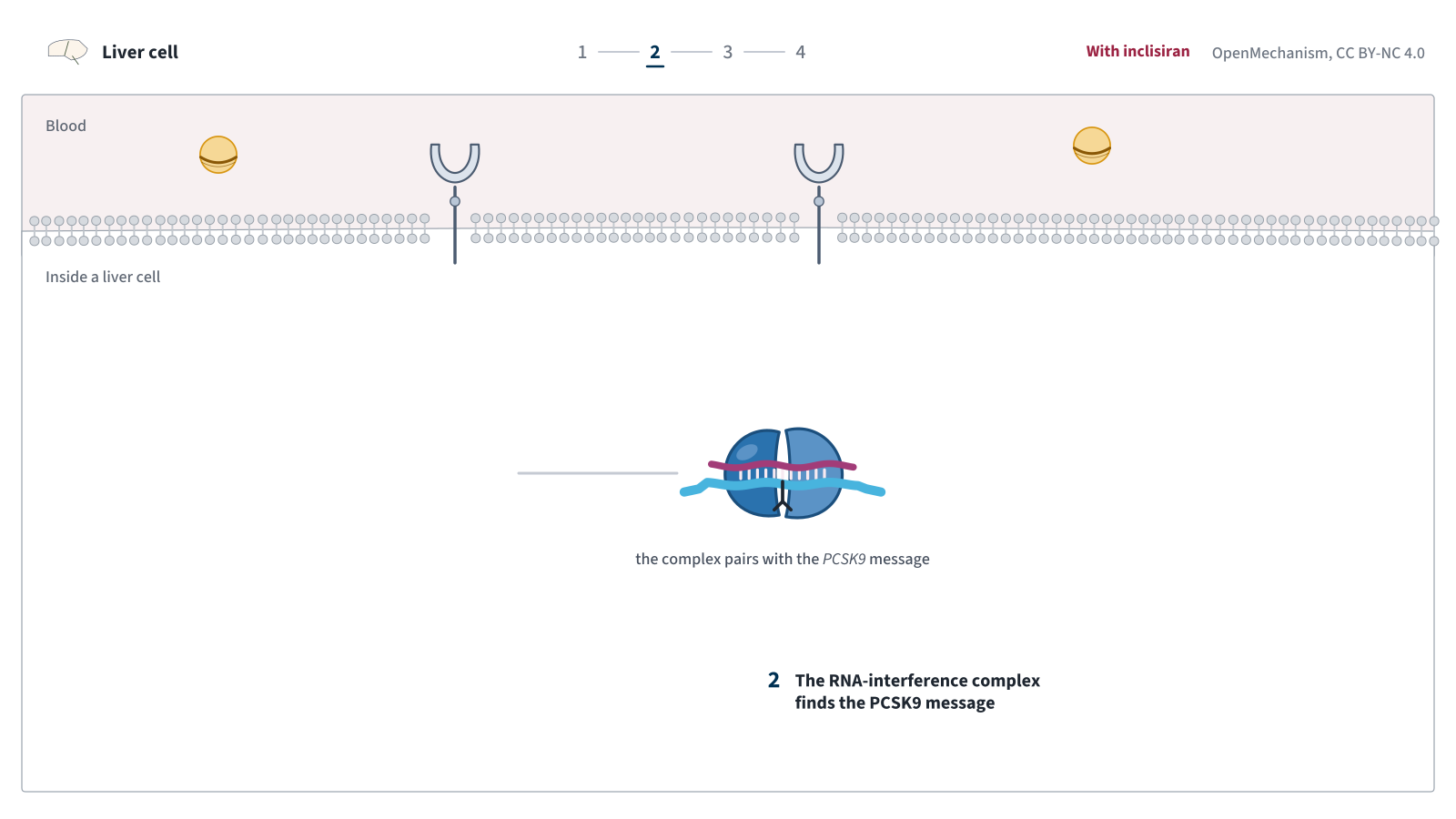
Step 2: The glyph approach marks the source RNAi relation. No guide pairing register, AGO2 pose or kinetic rate is inferred.
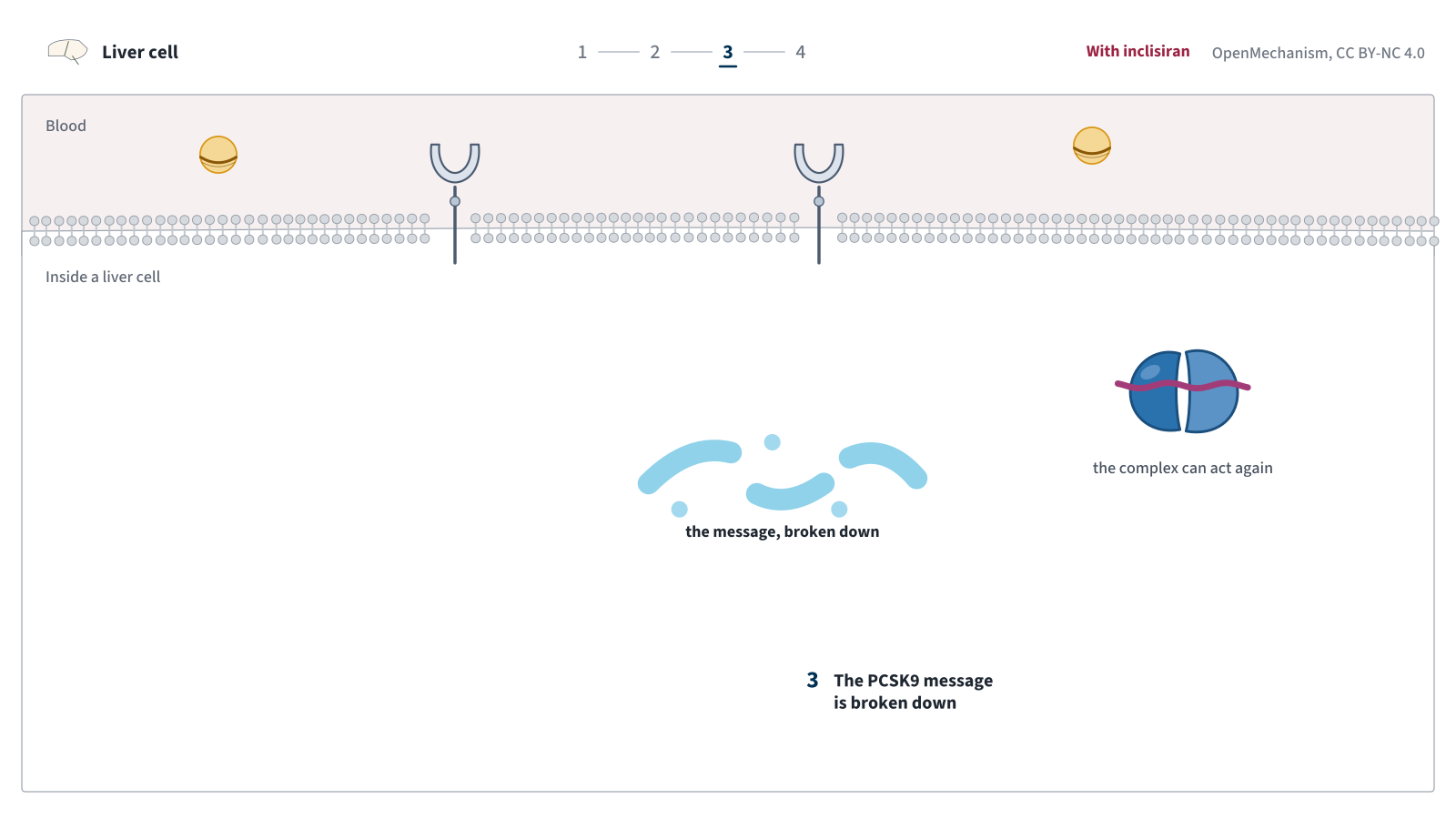
Step 3: PCSK9 mRNA changes to the original fragment reference artwork. Fragment count, sequence ends and cleavage positions are not measured.
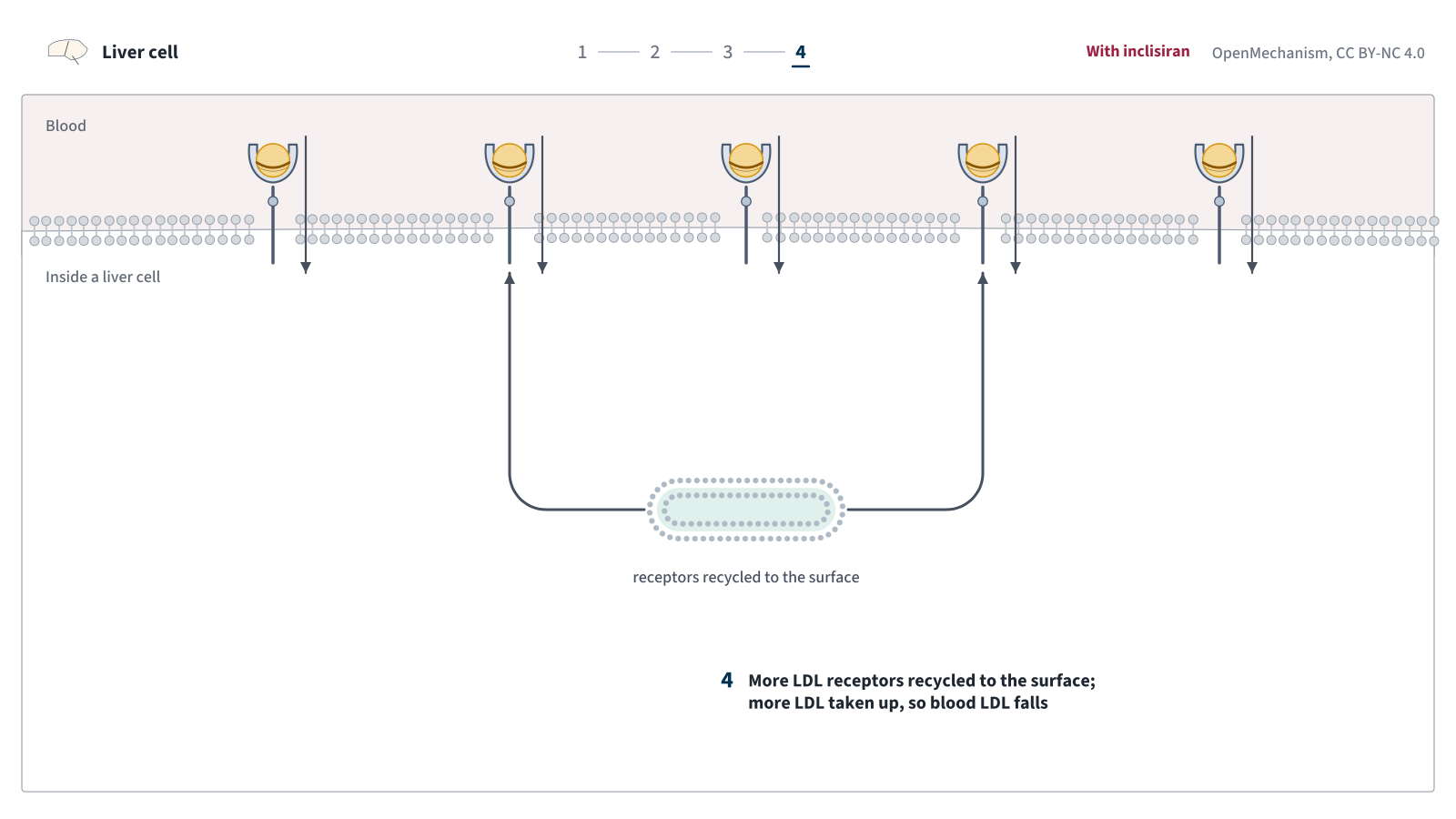
Step 4: The label links this action to greater LDL receptor recycling/surface availability and increased LDL uptake. These are qualitative outcome cues.
Tran D. How inclisiran breaks down the PCSK9 message [Internet]. OpenMechanism; 2026 [updated 2026 Oct 13; cited 2026 Oct 13]. Available from: https://openmechanism.com/animations/inclisiran-cleavage